
The short answer
Intermittent fasting is an eating pattern that focuses primarily on when you eat. Instead of prescribing one special list of foods, it creates planned periods of eating and fasting. The approach has become popular for weight management and metabolic health, but the evidence is more nuanced than many online claims suggest.
Intermittent fasting can be a practical option for some adults. Recent systematic reviews of randomized trials suggest that time-restricted eating can improve body weight, waist circumference, blood pressure, fasting glucose, insulin and triglycerides compared with usual eating patterns. The size of these effects varies, however, and fasting should not be treated as a cure-all or as clearly superior to every sustainable calorie-reduction strategy.
Key takeaways
- Intermittent fasting (IF) alternates periods of eating with periods of little or no caloric intake.
- Time-restricted eating can produce modest improvements in weight and several metabolic markers for some adults, but results vary.
- There is no single fasting schedule that is best for everyone, and longer fasting is not automatically better.
- Diet quality, adequate nutrition, physical activity, sleep and sustainability still matter.
- Fasting can interact with medical conditions and medications, particularly diabetes treatments.
A 2025 umbrella review evaluated 12 meta-analyses covering 122 health-outcome associations and found supportive evidence for several weight and metabolic outcomes, while also highlighting differences in evidence quality. A newer network meta-analysis of 41 randomized trials likewise found improvements across several metabolic measures with time-restricted eating.
What is intermittent fasting?
Intermittent fasting is an umbrella term for eating patterns that deliberately alternate eating and fasting periods. The best-known version is time-restricted eating (TRE), in which meals are consumed within a consistent daily window—for example, 10 hours, 8 hours or sometimes less.
Other approaches include the 5:2 pattern and alternate-day fasting. These differ substantially in how restrictive they are, so results from one method should not automatically be applied to another.
Common intermittent fasting methods
| Method | How it works | Example | Practical note |
|---|---|---|---|
| 12:12 | 12-hour fast / 12-hour eating window | 7 a.m.–7 p.m. eating | Gentle starting point |
| 14:10 | 14-hour fast / 10-hour eating window | 8 a.m.–6 p.m. eating | Moderate daily restriction |
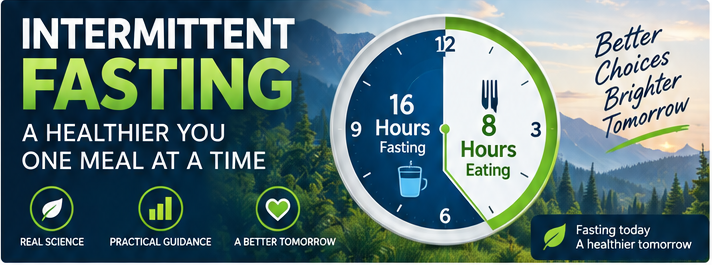
| 16:8 | 16-hour fast / 8-hour eating window | Noon–8 p.m. eating | Popular, but not a magic threshold |
| 5:2 | Usual eating 5 days; substantial restriction 2 days | Two nonconsecutive lower-intake days | More day-to-day variation |
| Alternate-day | Alternates higher-intake and fasting/very-low-intake days | Every other day | More restrictive and harder to coordinate with some medications |
For many beginners, a consistent overnight fast is easier to integrate into normal life than an aggressive schedule. There is no good reason to assume that a more extreme plan is automatically healthier.
What happens in the body during a fast?
After eating, the body digests and stores nutrients and uses incoming glucose and other fuels. As time without food increases, insulin generally falls, liver glycogen contributes to maintaining blood glucose, fat oxidation increases and ketone production may rise. These changes occur gradually and vary among individuals.
That is why claims such as “fat burning starts at exactly hour 12” or “autophagy switches on at exactly hour 18” should be treated skeptically. Human metabolism does not operate on a universal stopwatch.
What benefits does the evidence support?
Weight and body composition
Intermittent fasting often results in modest weight loss, especially when the eating pattern reduces total energy intake. In randomized-trial syntheses, the average advantage is generally modest rather than dramatic. Whether fasting is easier to sustain than conventional calorie restriction depends heavily on the individual.
Glucose and insulin
Recent meta-analyses report modest improvements in fasting glucose, insulin and insulin-resistance measures with some time-restricted eating approaches. A 2026 meta-analysis focused specifically on 16:8 TRE found small improvements in fasting glucose, insulin and HOMA-IR across 23 randomized trials.
Blood pressure and lipids
Some randomized-trial syntheses report improvements in systolic blood pressure and triglycerides. Effects are not uniform across every lipid or cardiovascular marker, and longer-term clinical outcomes remain less certain.
Is intermittent fasting better than ordinary calorie restriction?
Not necessarily. Both approaches can work. Some studies find small advantages for particular fasting strategies, while others show broadly similar results when total calorie reduction and adherence are comparable. The practical question is often which healthy pattern a person can follow consistently without compromising nutrition, medication safety or quality of life.
Does the timing of the eating window matter?
Possibly. Research increasingly examines circadian timing as well as fasting duration. A network meta-analysis of randomized trials found that earlier time-restricted eating tended to rank favorably for several metabolic outcomes, although the optimal eating-window length was not consistently clear. That does not mean everyone must eat very early; work schedules, sleep, family meals and adherence also matter.
A sensible way to start
- Begin conservatively. A roughly 12-hour overnight fast may simply eliminate late-night eating.
- Keep the schedule consistent. If it feels comfortable and medically appropriate, consider gradually moving toward 14:10 or another sustainable window.
- Do not neglect food quality. Fasting does not make an ultra-processed diet nutritious. Prioritize adequate protein, vegetables and fruit, fiber-rich foods and appropriate healthy fats.
- Stay appropriately hydrated. Typical time-restricted eating restricts calories, not water.
- Pay attention to symptoms. Persistent dizziness, fainting, confusion, severe weakness or other concerning symptoms are reasons to stop and seek appropriate medical advice.
Affiliate links: we may earn a commission at no additional cost to you. As an Amazon Associate I earn from qualifying purchases. Prices and availability can change.
For a day-by-day example, follow our seven-day beginner plan. If a timer would make a suitable schedule easier to follow, see how to choose a fasting app before deciding whether you need one.
Who should be especially cautious?
For a fuller discussion of medications, medical conditions, pregnancy, eating disorders and warning signs, see our fasting safety guide.
People using insulin or certain glucose-lowering medications require particular caution. NIDDK notes that hypoglycemia is a major fasting risk in diabetes; hyperglycemia, dehydration and, in some circumstances, diabetic ketoacidosis can also occur. Medication changes should be planned with a clinician rather than improvised from an internet fasting schedule.
Fasting also deserves individualized medical guidance during pregnancy or breastfeeding, in people with a current or previous eating disorder, and in people whose health conditions, frailty or medications make reduced food or fluid intake risky.
“Promising” is not the same as “proven for everyone.” Most fasting studies measure intermediate outcomes such as weight, glucose, insulin or lipids over weeks or months. We should be cautious about extending those results into claims about curing disease or increasing lifespan.
Frequently asked questions
Do I need to follow 16:8?
No. Sixteen hours is a popular convention, not a biologically mandatory threshold. A shorter overnight fasting period may be more practical for many people.
Can I drink water while fasting?
In ordinary time-restricted eating, calorie restriction does not normally require restricting water. Medical or religious fasts can have different rules.
Does black coffee break a fast?
That depends on what you mean by “break.” Plain black coffee contributes very few calories, but specific fasting goals and medical situations differ. See our dedicated guide to what breaks a fast.
Can I exercise while fasting?
Many healthy adults can exercise during a fasting window, but training intensity, hydration, medications, nutrition and individual tolerance matter. See exercise while fasting.
Where to go next
Sources & further reading
- Systematic review and network meta-analysis of time-restricted eating and metabolic outcomes (41 randomized trials)
- Intermittent fasting for weight management and metabolic health: updated umbrella review
- Network meta-analysis of intermittent fasting strategies and cardiometabolic risk factors
- Systematic review and meta-analysis of 16:8 time-restricted eating
- NIDDK: Fasting safely with diabetes
- NIDDK: Intermittent fasting and type 2 diabetes
Editorial standard: Fasting Metabolic Health distinguishes established findings from preliminary evidence and avoids assigning universal metabolic “switch” times where human evidence does not support them.