
Fasting safety depends on the person, the fasting method and the medical context. Intermittent fasting may be reasonable for some adults, but it is not appropriate for everyone and longer fasting generally carries more risk.
The short answer
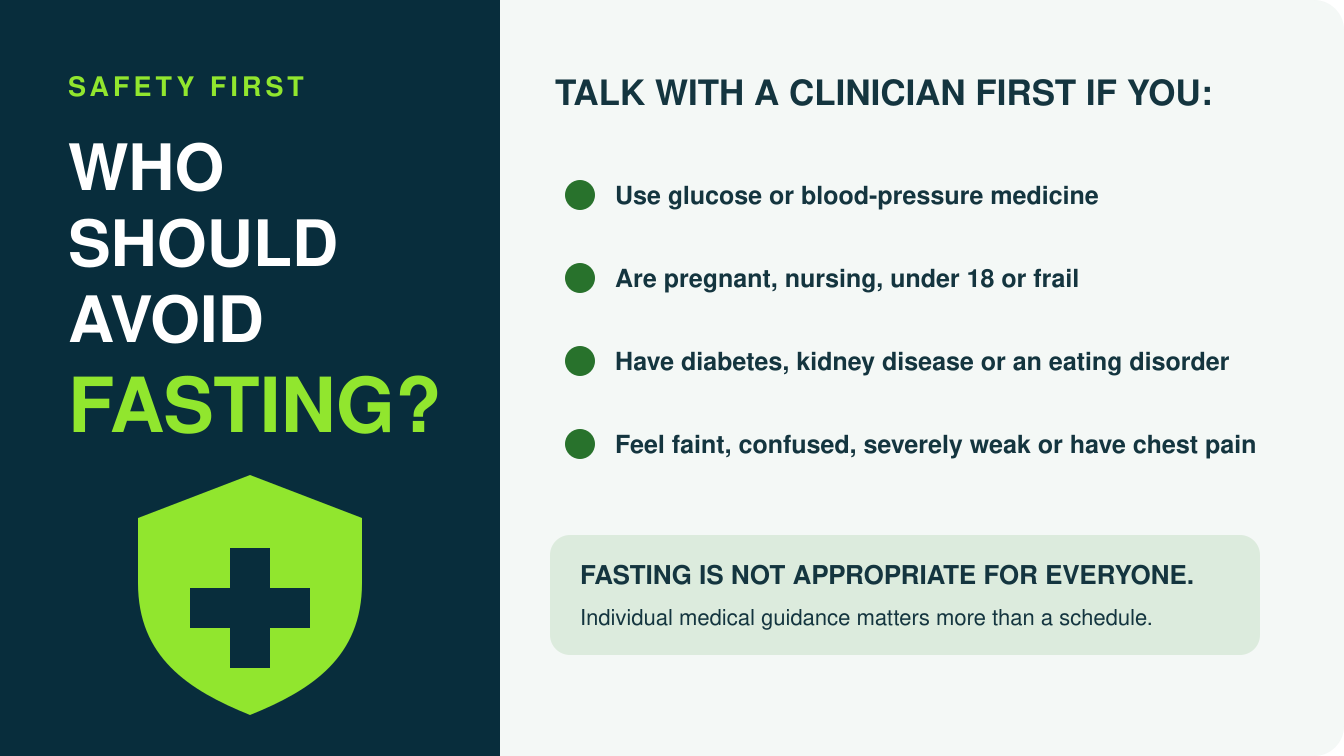
Children and adolescents, people who are pregnant or breastfeeding, people with a history of eating disorders, and many people with type 1 diabetes should not start intermittent fasting without specialized medical guidance. People taking glucose-lowering, blood-pressure or fluid-altering medicines may also need individualized advice.
Good fasting safety means recognizing that “natural” does not mean risk-free. A fasting plan should never require ignoring fainting, severe weakness, confusion, dehydration or other concerning symptoms.
Key takeaways
- Fasting is not recommended for every age, life stage or medical condition.
- Insulin and some diabetes medicines can create hypoglycemia risk during fasting.
- Pregnancy, breastfeeding and growth require dependable nutrition.
- A history of eating disorders is an important reason for caution or avoidance.
- Longer fasts require more attention to hydration, medications and nutritional status.
Who should avoid intermittent fasting?
Quick answer: Children and teens, people who are pregnant or breastfeeding, people with type 1 diabetes taking insulin, and people with a history of eating disorders are among the groups commonly advised not to start intermittent fasting without appropriate medical guidance. People taking glucose-lowering medicines or managing other medical conditions may also need an individualized plan.
Johns Hopkins advises against intermittent fasting for children and teens under 18, people who are pregnant or breastfeeding, people with type 1 diabetes taking insulin, and people with a history of eating disorders. Individual circumstances vary, but these groups illustrate why fasting safety starts with identifying higher-risk situations.
Diabetes and glucose-lowering medicines
NIDDK identifies hypoglycemia as a major fasting risk for people with diabetes. Insulin and sulfonylureas are particularly important because skipping meals while continuing glucose-lowering medication can drive blood glucose too low. Cutting medication too aggressively can create the opposite problem—hyperglycemia and, in susceptible people, ketoacidosis.
People with diabetes who want to fast need a plan for medication timing, glucose monitoring, hydration and when to stop the fast. That plan should come from a clinician familiar with their treatment.
Pregnancy and breastfeeding
Pregnancy and lactation create additional nutritional and hydration demands. Intermittent fasting for weight loss should not be treated as a routine lifestyle experiment during these periods. Personalized obstetric or medical advice is appropriate.
Children and adolescents
Growing children and teenagers need adequate energy and nutrients. Restrictive fasting schedules can interfere with normal nutrition and can also overlap with unhealthy restrictive eating patterns. Pediatric nutrition decisions belong with qualified health professionals.
Eating disorders and disordered eating
Rigid fasting windows can trigger or reinforce restrictive, obsessive or binge-restrict cycles in susceptible people. A current or past eating disorder is therefore a significant fasting safety concern. Weight-loss benefits reported in general adult trials do not outweigh that individualized risk.
Older, frail or underweight adults
People who are underweight, frail or struggling to maintain muscle and adequate calorie intake may be poor candidates for fasting. The risk-benefit calculation is different when preventing weight loss, sarcopenia or malnutrition is the priority.
Kidney, heart and blood-pressure conditions
Fluid and electrolyte changes can matter more in people with kidney disease, heart failure or blood-pressure disorders. Diuretics and medicines affecting potassium or blood pressure can further change risk. Do not add salt or electrolyte supplements simply because a fasting influencer recommends them.
When medications require food
Some medicines are prescribed with food to improve absorption or reduce gastrointestinal irritation. Others can alter glucose, blood pressure or fluid balance. Medication instructions take priority over a preferred eating window. If a schedule conflicts with treatment, change the fasting plan—not the prescription on your own.
Warning signs to stop a fast
Persistent dizziness, fainting, confusion, severe weakness, repeated vomiting, inability to maintain hydration, chest pain or symptoms of significant hypoglycemia are not achievements to “push through.” Stop the fast and seek appropriate medical evaluation. Severe symptoms may require urgent care.
Longer fasting is not simply more intermittent fasting
Risk generally becomes more consequential as food restriction extends. Hydration, electrolyte balance, nutritional status and refeeding become increasingly relevant. Someone who tolerates 14:10 time-restricted eating cannot assume a multi-day fast is equally appropriate.
How to make a lower-risk plan
For adults who are reasonable candidates, conservative fasting safety principles include choosing a manageable schedule, maintaining appropriate hydration, eating a nutritionally adequate diet during eating periods, avoiding compensatory binges, and stopping when significant symptoms occur. Our fasting schedules comparison can help distinguish less restrictive schedules from more demanding approaches.
Practical bottom line
Intermittent fasting is an eating pattern, not a test of willpower. The safest schedule is one compatible with your health, medications, nutritional needs and daily life. When those factors conflict with fasting, health takes priority.
Fasting and a history of recurrent fainting or low blood pressure
People who already experience orthostatic dizziness, fainting or unusually low blood pressure may have more difficulty with changes in food, fluid or sodium intake. Blood-pressure medicines can add another variable. Good fasting safety means discussing recurrent symptoms with a clinician rather than assuming they are a normal part of adaptation.
Illness, surgery and recovery are different situations
Acute illness can change fluid needs, glucose control and medication requirements. Recovery from surgery, infection or injury can also increase the importance of adequate protein, calories and micronutrients. A fasting routine that is reasonable when healthy may not be appropriate during recovery.
Medical fasting before a procedure is a separate issue. Follow the hospital or clinician’s instructions exactly, including directions about clear liquids and medications. Internet fasting rules should never replace procedural instructions.
Fasting with gastrointestinal disease
Some people find meal timing affects reflux, nausea, abdominal pain or bowel symptoms. Others take medicines that need to be taken with food. The presence of gastrointestinal disease does not produce one universal rule, but persistent symptoms are a reason to individualize the plan rather than simply lengthening the fasting window.
Hydration is part of fasting safety
Many intermittent-fasting approaches allow calorie-free fluids, but some cultural, religious or personal fasting practices also restrict water. Fluid restriction changes the risk substantially, particularly in heat, during exercise, in older adults and for people taking diuretics.
Severe thirst, very low urine output, confusion, fainting or inability to keep fluids down warrants attention. Our guide to electrolytes during fasting explains why blindly adding salt or potassium is not a substitute for evaluating the cause of symptoms.
Fasting is not a treatment for every metabolic problem
Intermittent fasting can be one way to structure eating, and research suggests benefits for some cardiometabolic outcomes in selected adults. It is not a replacement for appropriate treatment of diabetes, hypertension, lipid disorders or other medical conditions. Medication and monitoring plans should be adjusted by the clinicians responsible for them.
This distinction is central to fasting safety: a potentially useful eating pattern becomes unsafe when it causes someone to delay needed treatment or change medication without supervision.
Mental and behavioral warning signs matter too
Safety is not limited to laboratory values. If fasting produces persistent anxiety about eating, compulsive clock-watching, binge-restrict cycles, social withdrawal or guilt after normal meals, the pattern may be doing more harm than good. People with current or previous eating disorders deserve particular caution and professional support.
Start conservatively if fasting is appropriate for you
Adults without major contraindications do not need to begin with an aggressive schedule. A consistent overnight fast or a 12:12 pattern may be easier to evaluate before considering a narrower eating window. Our fasting schedules comparison explains how common approaches differ.
Changing one variable at a time also makes it easier to identify problems. Combining a new fasting schedule, severe carbohydrate restriction, a large exercise increase and multiple supplements simultaneously can make symptoms difficult to interpret.
Questions to ask before starting
- Do I take a medicine that depends on meal timing or can lower glucose or blood pressure?
- Am I pregnant, breastfeeding, underweight, frail or still growing?
- Do I have a history of an eating disorder or problematic restrictive eating?
- Am I able to meet my protein, calorie, vitamin and mineral needs during the eating window?
- Does fasting fit my work, exercise and sleep schedule without causing recurrent symptoms?
If any answer raises concern, individualized medical or nutrition advice is more useful than trying to follow a generic fasting timetable.
Fasting safety is more important than fasting duration
A longer fast is not automatically a better fast. The meaningful outcomes are whether the eating pattern is safe, sustainable, nutritionally adequate and useful for the person’s goals. There is no health benefit in ignoring warning signs simply to reach a target number of hours.
Nutritional adequacy belongs in every safety assessment
A fasting schedule can look reasonable on a clock and still be a poor fit if the eating window is too short to meet energy, protein, vitamin and mineral needs. This matters especially for people who are already losing weight unintentionally, have low appetite or are trying to preserve muscle. Fasting safety includes what happens during the eating window, not only the hours without food.
Work and driving can change the consequences of symptoms
Lightheadedness or impaired concentration is concerning in any setting, but the consequences can be greater when driving, operating machinery, working at heights or performing other safety-sensitive tasks. A fasting routine that repeatedly produces symptoms during these activities should be reconsidered rather than treated as a test of discipline.
Alcohol and fasting are a poor combination
Alcohol can impair judgment and contribute to dehydration, and its effects may feel stronger when little food has been consumed. It also adds calories without improving the nutritional quality of the eating window. For people choosing intermittent fasting, avoiding alcohol on an empty stomach is a sensible fasting safety precaution.
Repeated symptoms deserve evaluation
Occasional hunger before a meal is different from recurrent fainting, confusion, palpitations, severe weakness, persistent vomiting or symptoms suggestive of hypoglycemia. Do not normalize significant symptoms simply because they occur during a fast. Stop the fast and seek appropriate care when symptoms are severe, unusual or persistent.
More fasting is not necessarily more benefit
Health effects seen with one intermittent-fasting schedule cannot automatically be extrapolated to much longer fasting. Increasing fasting duration also reduces the time available for nutrition and can make medication, hydration and exercise management more complicated. A conservative schedule that is sustainable may be preferable to repeatedly attempting longer fasts.
Review the plan when circumstances change
Medication changes, a new diagnosis, pregnancy, surgery, acute illness, substantial weight loss or a major increase in exercise can all change whether a previously tolerated fasting routine remains appropriate. Good fasting safety is an ongoing decision rather than a one-time clearance.
The central principle is straightforward: fasting should serve health goals, not compete with them. When nutrition, treatment, recovery or safety requires eating, the fasting schedule should be the flexible part of the plan.