
The short answer
Fasting schedules range from a simple 12:12 overnight fast to 14:10 or 16:8 time-restricted eating, the 5:2 approach and alternate-day fasting. Choosing among them can be confusing because some restrict the hours you eat each day, while others substantially restrict intake on entire days.
For a healthy adult who wants to experiment with time-restricted eating, a modest overnight schedule such as 12:12 or 14:10 is generally less restrictive than 16:8, 5:2 or alternate-day fasting. There is no high-quality evidence showing that everyone needs a 16-hour fast, and longer fasting is not automatically better.
Key takeaways
- 12:12 and 14:10 are relatively gentle daily time-restricted eating schedules and may be easier to sustain.
- 16:8 is popular and well studied, but 16 hours is not a proven metabolic “magic number.”
- 5:2 and alternate-day fasting create larger day-to-day changes in food intake and can be harder to coordinate with medications and social schedules.
- Research does not establish one fasting schedule as best for everyone; adherence, nutrition quality and safety matter.
- People who use insulin or other glucose-lowering medication should not independently change meal timing without discussing medication safety with their healthcare team.
Across randomized trials, intermittent fasting can help some people reduce body weight and improve selected metabolic markers, but results often resemble those achieved with conventional continuous calorie restriction. A 2023 meta-analysis comparing time-restricted eating, alternate-day fasting and 5:2 with continuous energy restriction found no overall superiority for body weight or most cardiometabolic outcomes when the intermittent approaches were combined.
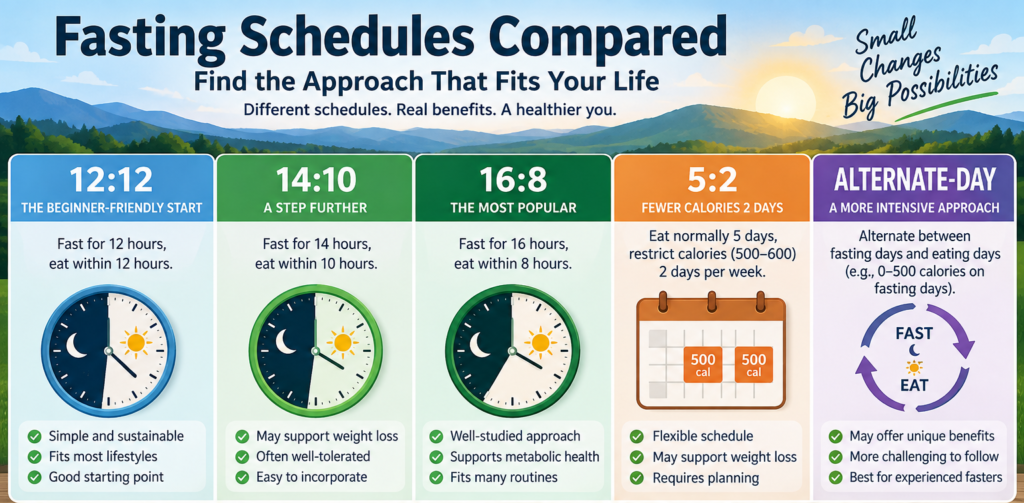
Fasting schedules at a glance
Comparing fasting schedules side by side makes the practical differences easier to see: daily time-restricted eating changes the eating window, while 5:2 and alternate-day approaches change intake across the week.
| Schedule | Typical pattern | Relative restriction | Best fit may be |
|---|---|---|---|
| 12:12 | 12-hour fast, 12-hour eating window daily | Low | Beginners; reducing late-night eating |
| 14:10 | 14-hour fast, 10-hour eating window daily | Low–moderate | People wanting a modest daily window |
| 16:8 | 16-hour fast, 8-hour eating window daily | Moderate | People comfortable skipping or delaying a meal |
| 5:2 | Usual intake 5 days; very low intake on 2 days | Moderate–high | People who prefer weekly rather than daily restriction |
| Alternate-day fasting | Alternating usual-intake and fasting/very-low-intake days | High | People who tolerate substantial day-to-day variation |
These labels describe broad patterns rather than rigid medical prescriptions. Research protocols differ in permitted calories, eating-window timing and the foods participants consume.
12:12 fasting
A 12:12 schedule creates a 12-hour overnight fasting period—for example, finishing dinner at 7 p.m. and eating breakfast at 7 a.m. For many people this resembles an ordinary meal schedule with late-night snacking removed. See our 12-hour fast rules and example schedules for the practical details.
Potential advantages
It is relatively easy to understand, leaves substantial time for meals and can be compatible with family and work schedules. It can also be a conservative way to determine how you tolerate a defined overnight fast.
Limitations
There is less research isolating 12:12 specifically than there is for narrower time-restricted eating windows. It should not be marketed as producing guaranteed weight loss or a specific metabolic switch.
14:10 fasting
A 14:10 schedule extends the overnight fast while preserving a 10-hour eating window. An example is eating between 8 a.m. and 6 p.m., although the window can be shifted to fit daily life.
This can be a practical middle ground: more structured than 12:12 without compressing all meals into eight hours. As with other schedules, outcomes depend partly on what and how much is eaten during the eating window.
16:8 fasting
With 16:8, all meals are usually consumed within an eight-hour window. Mayo Clinic describes time-restricted eating as limiting food intake to part of each day and notes that fasting periods can extend to about 16 hours. The popularity of 16:8 does not mean 16 hours has been established as a universal optimum.
Research on time-restricted eating suggests modest improvements in weight and some glucose, insulin, blood-pressure and lipid measures in certain populations. However, study designs vary, and longer-term clinical outcomes remain less certain.
Is 16:8 better than 14:10?
Not necessarily. A narrower eating window may reduce opportunities to eat, but it can also make adequate nutrition, exercise fueling, medication timing and social meals more difficult. The more sustainable schedule may be the better practical choice.
5:2 fasting
The 5:2 approach uses five days of usual eating and two days of substantial calorie restriction. Definitions vary: some versions use very low calorie intake rather than a complete fast. Mayo Clinic groups 5:2 among full-day intermittent-fasting approaches.
The advantage is that most days do not require a restricted eating window. The tradeoff is greater variation between normal and restricted days, which can complicate hunger management and medication planning.
Alternate-day fasting
Alternate-day fasting alternates usual-intake days with fasting or very-low-intake days. Modified alternate-day protocols may permit a fraction of usual calories on the restricted day.
This is one of the more demanding schedules. NIDDK notes that intermittent fasting performed two days per week or every other day can be more complicated for people with diabetes because medication adjustments may vary with fasting days. Such changes should be handled with medical supervision rather than by trial and error.
Which schedule works best for weight loss?
No schedule consistently wins for everyone. In a meta-analysis of 28 randomized trials, time-restricted eating, alternate-day fasting and 5:2 combined did not produce superior overall changes in body weight or most cardiometabolic markers compared with continuous energy restriction. Individual subgroups and outcomes differed, but the larger lesson is that fasting is an alternative structure for energy restriction—not a guaranteed shortcut around energy balance.
That makes adherence important. A theoretically aggressive plan that repeatedly leads to overeating, poor sleep, inadequate protein or abandonment may be less useful than a modest schedule that fits everyday life.
Does earlier eating matter?
Affiliate links: we may earn a commission at no additional cost to you. As an Amazon Associate I earn from qualifying purchases. Prices and availability can change.
Meal timing may matter in addition to fasting duration. Some research on time-restricted eating suggests earlier eating windows can perform favorably for certain metabolic outcomes. But practical considerations—work, family meals, exercise and sleep—also influence whether a schedule can be maintained.
Rather than assuming “later is bad” or “earlier is always best,” treat eating-window timing as one variable within the overall pattern.
How to choose a fasting schedule
- Start with your normal routine. Identify late-night eating or long grazing periods before choosing an aggressive fast.
- Favor the least restrictive schedule that meets your goal. Moving from a 14-hour daily eating span to 12 hours may be more realistic than immediately attempting 16:8.
- Protect nutrition quality. A shorter window should still allow adequate protein, fiber, micronutrients and total energy appropriate for you.
- Consider exercise and sleep. A window that makes training recovery or sleep worse may not be a good fit.
- Account for medications and health conditions. Meal timing can materially change the safety of insulin, sulfonylureas and other treatments.
- Reassess rather than escalate automatically. There is no rule that success requires progressively longer fasts.
Fasting studies vary in duration, population, calorie intake and protocol. Short-term changes in weight, glucose or insulin should not be interpreted as proof that one schedule prevents disease, extends lifespan or is superior for every person.
Who should be especially cautious?
For medical conditions, medications and warning signs, read our fasting safety guide before choosing a schedule.
Intermittent fasting is not appropriate for everyone. Mayo Clinic advises particular caution for people with eating disorders, pregnancy or breastfeeding, and people at high risk of bone loss and falls. Diabetes adds medication-specific risks. NIDDK identifies hypoglycemia as a major concern and also discusses hyperglycemia, dehydration and diabetic ketoacidosis in susceptible people.
If fasting produces fainting, confusion, persistent dizziness, severe weakness, dehydration or other concerning symptoms, stop and seek appropriate medical advice rather than trying to “push through” the fast.
Frequently asked questions
Is 12 hours long enough to count as fasting?
Yes. A fast is simply a defined period without food; there is no scientifically established rule that a fast only “counts” after 16 hours. Whether 12:12 produces a particular health outcome is a separate question.
Should beginners start with 16:8?
There is no requirement to do so. A less restrictive overnight schedule can be easier to evaluate and sustain.
Can I change schedules from day to day?
Healthy adults sometimes vary meal timing, but consistency makes it easier to assess tolerance and maintain routines. People taking medications affected by food intake should discuss variable fasting days with their clinician.
Is alternate-day fasting better than 16:8?
Evidence does not establish alternate-day fasting as universally superior. It is more restrictive and may be less practical for some people.
Where to go next
Sources & further reading
- Systematic review and meta-analysis comparing time-restricted eating, alternate-day fasting and 5:2 with continuous energy restriction
- Mayo Clinic: Intermittent fasting—benefits, approaches and safety
- NIDDK: Fasting safely with diabetes
- NIDDK: Intermittent fasting and type 2 diabetes
Editorial standard: Fasting Metabolic Health distinguishes practical fasting schedules from medical prescriptions and does not treat a specific fasting duration as a universal metabolic threshold.