
In a yeast cell deprived of nutrients, Yoshinori Ohsumi found a way to watch something that usually vanished too quickly to see.
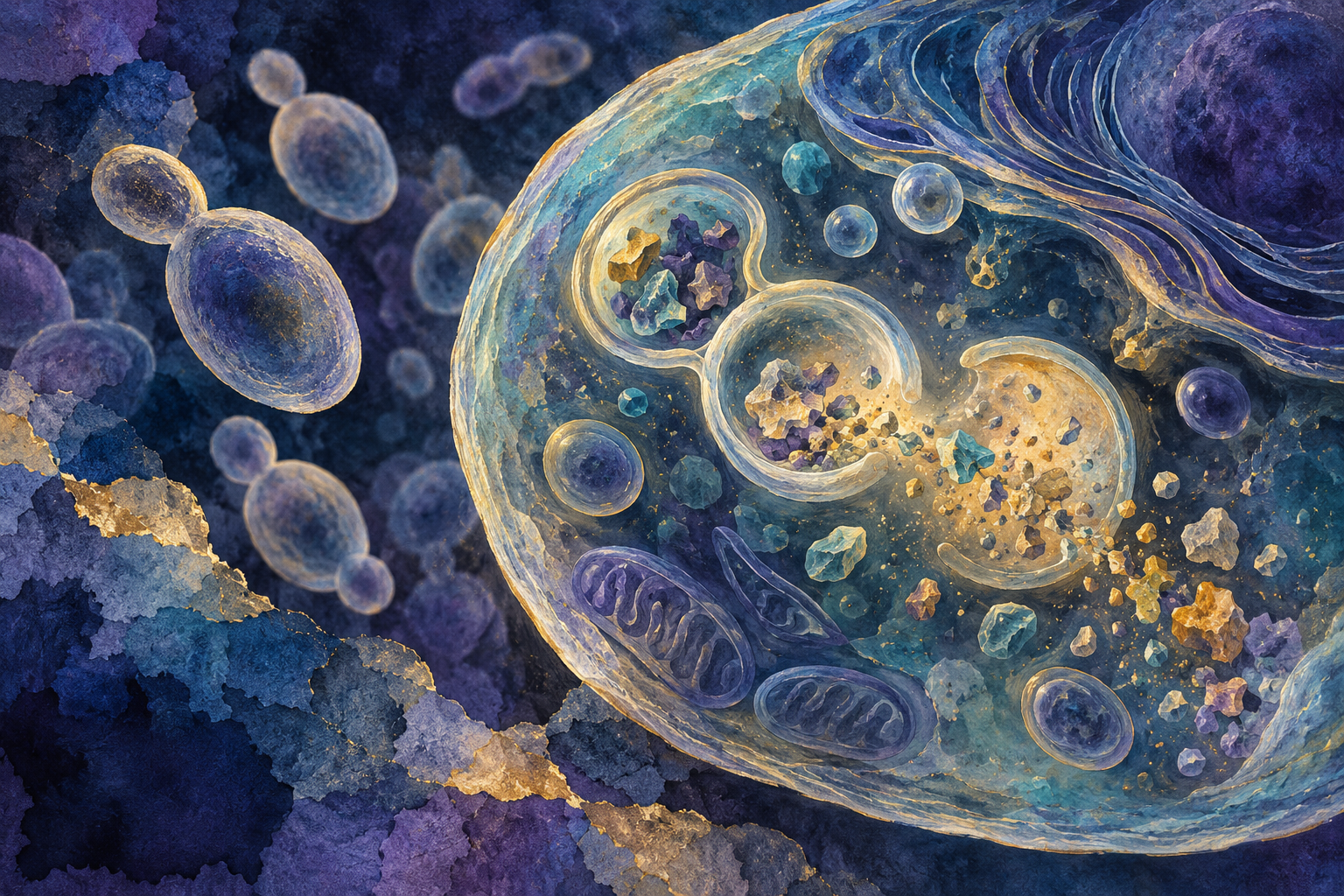
Original AI-generated editorial artwork depicting cellular recycling and budding yeast. Conceptual illustration, not a microscope image or a depiction of proven human tissue regeneration.
Material carried into the cell’s digestive compartment accumulated instead of disappearing. By disabling some of the enzymes that normally broke it down, the Japanese biologist had made a hidden process visible.
Those experiments opened a path into one of biology’s most consequential questions: how does a cell take itself apart, salvage the pieces, and keep living?
In 2016, Ohsumi received the Nobel Prize in Physiology or Medicine for discoveries of the mechanisms of autophagy. Today, that same process figures prominently in discussions of fasting, aging, and cellular renewal. The connection is compelling. Understanding it requires following the evidence from yeast to mice to people—and recognizing what changes along the way.
Source: The Nobel Assembly’s account of Ohsumi’s discoveries.
The experiment that made recycling visible
When Ohsumi established his laboratory in 1988, he focused on the yeast vacuole, a compartment with digestive functions comparable to those of a human cell’s lysosome.
The difficulty was catching the process in action. Cellular material entering the vacuole was normally broken down. His solution was to interrupt that digestion and deprive the yeast of nutrients. Small structures then accumulated where he could observe them.
The findings appeared in 1992. The next year, his group reported 15 genes essential for autophagy. Researchers now had a way to investigate the machinery behind the observation.
Ohsumi’s autobiography describes how collaboration with his wife Mariko’s laboratory helped identify the genes. The work emerged from persistent investigation of a basic biological problem: what happens inside a cell when material is delivered for destruction?
Sources: Nobel Prize scientific background and Ohsumi’s autobiography.
What a cell can salvage
Autophagy literally means “self-eating.” In biological terms, it is a way of breaking down cellular contents and making some of their components available for reuse.
In macroautophagy, the form most often discussed, a membrane encloses material inside the cell. The resulting compartment, an autophagosome, joins a lysosome. Enzymes then dismantle the contents.
The process can help clear damaged components and supply building blocks when nutrients are scarce. It belongs to the ordinary work of maintaining a cell, although its activity changes with circumstances.
That makes autophagy relevant to fasting. Nutrient deprivation can stimulate this recycling machinery in experimental systems. It also makes autophagy relevant to much more than fasting: researchers study its roles in development, infection, and disease.
Source: Nobel Prize scientific background.
Where cellular maintenance meets regeneration
Recycling components inside an existing cell and producing replacement cells are different biological tasks. Autophagy concerns the first; stem cells can contribute to the second.
That distinction does not make regeneration irrelevant to fasting. Research has explored both. It does mean that a finding about autophagy cannot, by itself, establish that fasting generates new cells or restores damaged tissue.
A cell may reuse building blocks without dividing. A stem cell may change its activity without repairing an organ. To understand a study, readers need to know which process researchers measured—and in which organism.
The promise behind the 72 hour fasting reports
In 2014, a team including Chia-Wei Cheng and Valter Longo reported that prolonged fasting cycles promoted self-renewal and regeneration of blood-forming stem cells in mice. Changes involving IGF-1 and PKA signaling helped explain the response.
The paper also examined cancer patients participating in an early clinical trial of fasting around chemotherapy. Its 72-hour regimen included 48 hours before treatment and 24 hours afterward. Researchers reported preservation of lymphocyte counts and the balance between lymphoid and myeloid blood cells compared with a shorter fasting regimen.
Those human results deserve attention. They are different from directly demonstrating increased stem-cell numbers in people. Mature immune-cell counts can provide clues about the blood-forming system, but they do not establish its underlying mechanism on their own.
The study therefore supports two distinct statements: fasting cycles promoted blood-forming stem-cell regeneration in mice, and preliminary human observations suggested protection of some blood-cell measures during chemotherapy. It did not establish a universal 72-hour prescription for rebuilding the human immune system.
Source: Cheng and colleagues, Cell Stem Cell, 2014.
The importance of eating again
Another experiment added an unexpected turn to the regeneration story.
A 2024 study in Nature found increased intestinal stem-cell proliferation and regenerative capacity in mice during refeeding after a fast. The return of food was a distinct biological phase, rather than merely the end of the intervention.
The same study also revealed a complication. In mice with experimentally induced loss of the tumor-suppressor gene Apc, post-fast refeeding increased tumor formation.
This does not establish that fasting causes cancer in people. It shows why increased cell production cannot automatically be treated as a benefit in every setting. The condition of the cells, their genetic changes, and the timing of feeding all matter.
For readers, the finding also challenges a familiar assumption: extending the period without food is not necessarily the same as increasing regeneration. Some effects emerge when nutrients return.
Source: Imada and colleagues, Nature, 2024 (open-access manuscript).
What researchers are finding in humans
Measuring autophagy in people is difficult. Researchers want to know whether material is moving through the recycling pathway, not simply whether a related gene or protein has changed.
A 2025 exploratory analysis in The Journal of Physiology measured that movement—autophagic flux—in certain blood immune cells from 121 adults with obesity.
Participants were assigned to standard care, daily calorie restriction, or an intervention combining restricted intake with a 20-hour fast on three nonconsecutive days each week.
At two months, changes did not differ significantly between groups. At six months, a post hoc analysis found a significant difference between the fasting and standard-care groups. Yet the fasting group did not show a significant increase from its own starting level. A tendency for autophagy to decline in the control group might partly explain the difference.
This is evidence worth pursuing. It does not establish increased autophagy in every organ, a longer human lifespan, or the effectiveness of every intermittent-fasting schedule.
Source: Bensalem and colleagues, The Journal of Physiology, 2025 (PubMed abstract).
A separate pilot study published in GeroScience in December 2025 examined two fasting-mimicking diets and a control diet in 30 adults. Researchers reported changes consistent with improved autophagic flux for one formulation, again using blood immune cells.
Its small sample, baseline differences between groups, and short assessment period limit the conclusions. The trial was sponsored by L-Nutra, which supplied the study diets; that relationship is relevant when weighing the evidence. The findings do not establish benefits across the whole body or prove a broadly effective fasting regimen.
Source: GeroScience fasting-mimicking diet pilot study.
A discovery without a universal countdown
Readers understandably want a number. How many hours without food will increase cellular recycling? When does regeneration begin?
The studies discussed here do not provide a universal answer. They investigate different interventions, different cells, and different outcomes. Autophagy is already part of cellular life; it does not await a single starting hour shared by everyone.
Ohsumi’s Nobel Prize recognized an explanation of biological machinery. The later stem-cell experiments explored additional mechanisms. Neither can be compressed into a guarantee that a particular fast renews the entire body.
That leaves room for interest without requiring certainty. Fasting can influence biological processes. The task now is to establish which changes help people, under what conditions, and at what cost.
What this means for fasting readers
A cellular mechanism is a reason to investigate an intervention carefully, rather than a reason to make it more extreme.
People with diabetes should discuss fasting with their healthcare team. Insulin and sulfonylureas may require clinician-directed adjustments; readers should not change medication doses independently to pursue a presumed cellular benefit. Preliminary chemotherapy findings likewise should not become advice to fast around cancer treatment without the treating team.
Source: NIDDK guidance on intermittent fasting and diabetes.
Ohsumi made an elusive process visible by interrupting it. His experiments gave science something more durable than a dietary promise: a way to ask better questions.
For fasting research, those questions remain open. What is being recycled? Which cells are being produced? Does the change improve health? The answers will determine how far a discovery inside baker’s yeast can travel into human medicine.
Related fasting guides
For practical next steps, read our beginner’s guide to intermittent fasting and fasting safety guide. For everyday meal planning, see how to break a fast.