
The short answer
If you are wondering what breaks a fast, the most accurate answer is: it depends on the purpose of the fast. Calories from food, sugar, cream, protein or other energy-containing ingredients end a strict zero-calorie fast. Water and genuinely calorie-free beverages generally fit a time-restricted eating fast, while medical, laboratory and religious fasts can have entirely different rules.
For ordinary intermittent fasting or time-restricted eating, water is the clearest choice. Plain black coffee and unsweetened tea are also commonly used because they contribute little or no meaningful energy. Add sugar, milk, cream, butter, protein powder, amino acids or caloric supplements, however, and you are no longer doing a strict zero-calorie fast.
Key takeaways
- Calories technically break a strict zero-calorie fast. The amount and type may still matter for your broader goal.
- Water is the simplest fasting beverage. Plain black coffee and unsweetened tea are commonly compatible with time-restricted eating protocols.
- Cream, milk, sugar, butter and protein provide energy and therefore end a strict fast.
- Supplements depend on their ingredients. Capsules may contribute negligible energy, while gummies, oils, protein, amino acids and some powders can contain meaningful calories or nutrients.
- Medical fasting rules override internet fasting advice. Follow the exact instructions given for surgery, procedures, laboratory tests or medications.
That does not mean one splash of milk automatically erases every metabolic effect of the preceding fasting hours. “Breaking a fast” is a practical definition, not a single biological switch. Weight management, ketosis, glucose control, research protocols, autophagy claims and pre-procedure fasting each require different levels of precision.
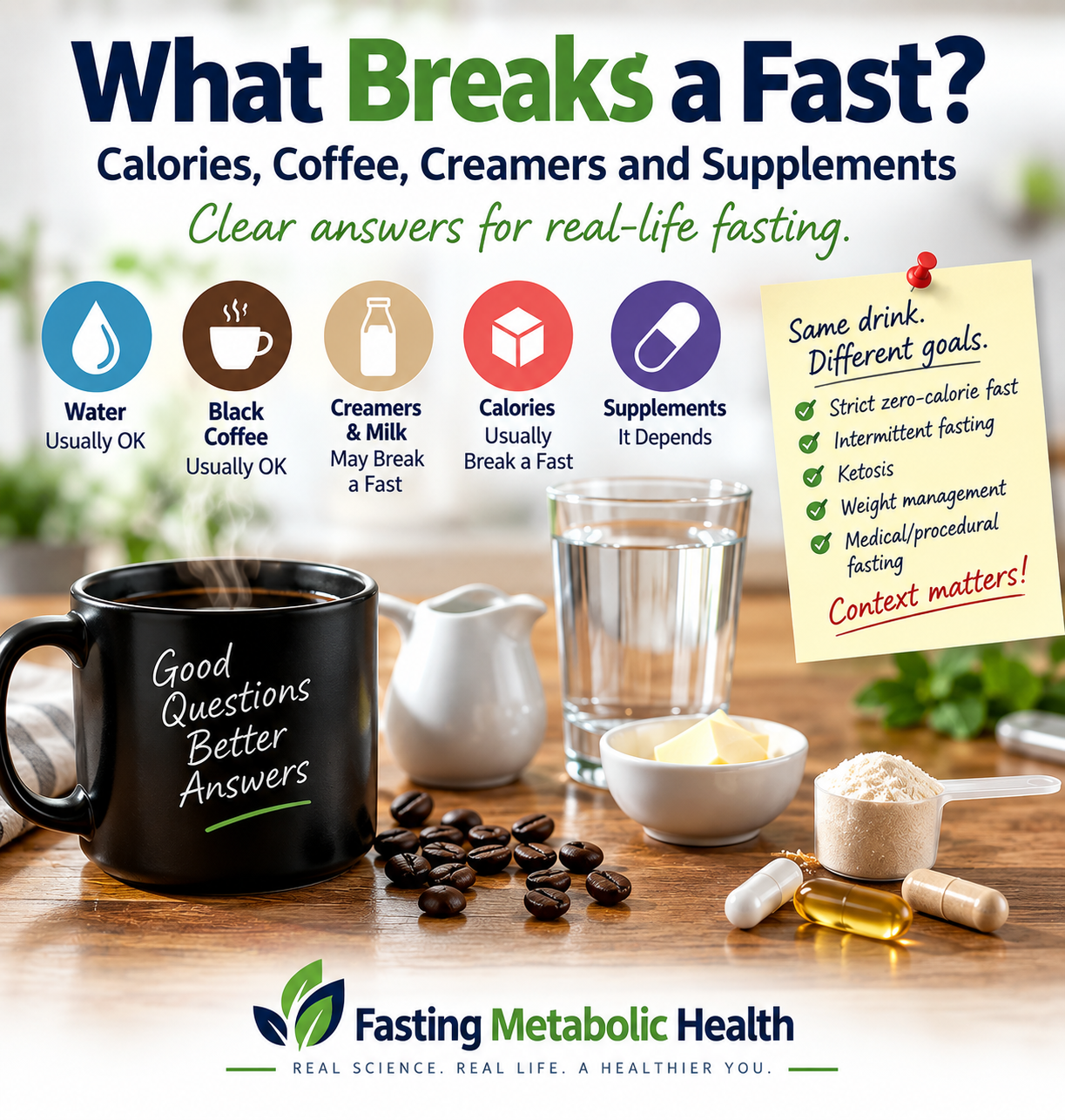
What does “breaking a fast” actually mean?
The phrase sounds binary, but human metabolism is not an on/off switch. After eating stops, digestion winds down, insulin and substrate availability change, stored glycogen is used, fat oxidation generally rises and ketone production can increase as fasting continues. These changes occur along a continuum and differ among individuals.
So the useful question is not only what breaks a fast, but what kind of fast are you trying to preserve? Someone practicing a 16:8 schedule for weight management may use a practical definition centered on avoiding meaningful calories. Someone preparing for anesthesia may need to follow precise clinical instructions about solids and liquids. Those situations should not be treated as interchangeable.
What breaks a fast? A quick comparison
| Item | Strict zero-calorie fast | Practical intermittent fasting | Why |
|---|---|---|---|
| Water | Generally compatible | Generally compatible | No calories; supports hydration |
| Black coffee | Often treated as compatible | Commonly compatible | Very little energy when plain |
| Unsweetened tea | Often treated as compatible | Commonly compatible | Very little energy when plain |
| Sugar or honey | Breaks it | Breaks it | Provides carbohydrate and calories |
| Milk or cream | Breaks it | Usually treated as breaking it | Provides fat, carbohydrate and/or protein |
| Butter or MCT oil | Breaks it | Breaks a zero-calorie fast | Provides substantial dietary energy |
| Protein/BCAAs/EAAs | Breaks it | Breaks it | Provides amino acids and usually energy |
| Noncaloric electrolytes | Usually compatible | Usually compatible | Check label for sugar or calories |
Does black coffee break a fast?
When people ask what breaks a fast, black coffee is one of the most common questions. Plain black coffee is commonly permitted during time-restricted eating and contains very little energy when nothing is added. Human time-restricted eating research commonly defines the fasting interval around zero-calorie beverages, and major clinical explanations of intermittent fasting commonly allow water and zero-calorie drinks.
The answer changes when coffee becomes breakfast in a cup. Sugar, syrups, milk, cream, sweetened plant milks, butter and oils add energy. A latte or sweetened specialty coffee should be counted as part of the eating period rather than as a fasting beverage.
Caffeine can also cause palpitations, jitteriness, reflux or sleep disruption in some people. Whether coffee technically fits your fasting rule is separate from whether it makes you feel well.
Does cream in coffee break a fast?
Yes, if by fasting you mean a strict no-calorie period. Dairy cream contains fat and calories; milk also supplies carbohydrate and protein. Even a small amount therefore changes the fast from zero-calorie to calorie-containing.
For weight management, however, context matters. A small amount of cream does not make the preceding hours meaningless, but repeatedly adding enough calories during the fasting window can reduce the energy deficit that makes time-restricted eating useful for some people. If you want an unambiguous fasting window, keep caloric additions inside your eating window.
Do artificial or non-nutritive sweeteners break a fast?
This is one of the least useful places for rigid internet rules. Non-nutritive sweeteners differ chemically, products can contain fillers or small amounts of carbohydrate, and individual glucose responses can vary. A truly noncaloric sweetener does not supply the same energy load as sugar, but that does not prove it is metabolically identical to water.
If your goal is a simple, reproducible fasting routine, water, plain coffee or unsweetened tea avoids the ambiguity. If your goal is weight management and a zero-calorie sweetener helps adherence, the practical question may be whether the overall eating pattern remains sustainable rather than whether a theoretical metabolic switch was perfectly preserved.
Do electrolytes break a fast?
In practical discussions of what breaks a fast, electrolytes need to be judged by their ingredients rather than the word on the label. Plain sodium, potassium or magnesium products with no sugar, protein or meaningful calories generally do not add significant energy. Our magnesium while fasting guide explains how capsules, gummies, product directions and medication timing differ. But “electrolyte” is a product category, not a guarantee. Some drinks and powders contain sugar, dextrose, maltodextrin or other caloric ingredients.
Affiliate links: we may earn a commission at no additional cost to you. As an Amazon Associate I earn from qualifying purchases. Prices and availability can change.
Read the nutrition and ingredient labels. More is not automatically better: excessive electrolyte supplementation can be harmful, particularly for people with kidney disease, heart disease or medications that affect sodium or potassium balance.
Use our electrolyte powder comparison checklist when reading labels, or search electrolyte powder listings on Amazon. Search results still need individual label and safety checks; “no sugar” alone does not establish zero calories.
Do vitamins and supplements break a fast?
For anyone deciding what breaks a fast, the formulation matters. It depends on the formulation. A conventional tablet or capsule may contain negligible calories. Gummies commonly contain sugar or carbohydrate. Fish oil and other oil-based supplements contain fat and energy. Protein powders, collagen, branched-chain amino acids (BCAAs) and essential amino acids (EAAs) supply nutrients and should not be considered part of a strict fast.
There is also a more important issue than what breaks a fast: some supplements and medicines are better tolerated or absorbed with food. Do not move a prescribed medication away from meals merely to protect a fasting window without checking the instructions or asking a pharmacist or clinician.
Does a tiny number of calories ruin a fast?
“Ruined” is usually the wrong concept. If you consume calories, a strict zero-calorie fast has technically ended. But physiology responds to dose, composition, timing and individual factors. Five calories and a 700-calorie meal are not metabolically equivalent even though neither satisfies a literal zero-calorie definition.
For weight loss, total energy intake remains important. Meta-analyses comparing intermittent fasting with conventional calorie restriction generally find that fasting can be an effective strategy, but it is not consistently superior when energy intake is comparable. That argues against treating a minor deviation as a metabolic catastrophe.
What about ketosis?
Ketosis is also not a simple yes/no explanation of what breaks a fast. Carbohydrate intake tends to suppress ketone production more directly than pure fat, but dietary fat still supplies calories and therefore ends a zero-calorie fast. A person can also remain in nutritional ketosis while eating a ketogenic diet.
For a fuller explanation, see our Ketosis vs. Fasting Ketosis guide. The important point is that “still producing ketones” and “still fasting” are not identical definitions.
What about autophagy?
Autophagy is a normal cellular recycling process that responds to nutrient and energy signaling. Fasting can influence pathways involved in autophagy, but popular claims that a particular food, coffee additive or exact number of calories instantly “turns autophagy off” go beyond what can currently be established in humans.
Human autophagy is difficult to measure across tissues, and there is no clinically validated consumer threshold that tells you exactly when fasting-induced autophagy starts or stops. We therefore do not use speculative autophagy timing as the deciding rule for whether a beverage “breaks” a fast.
Fasting for blood tests, surgery or procedures is different
Always follow the instructions from the healthcare facility. The allowed foods, beverages, medications and timing depend on the test or procedure. Advice intended for intermittent fasting should never override preoperative or laboratory instructions.
For example, eating before some blood tests can alter glucose or triglyceride measurements. Anesthesia-related fasting rules address aspiration risk and are a different medical question entirely. If instructions are unclear, contact the ordering clinician or facility rather than improvising from a general fasting article.
A practical rule for everyday intermittent fasting
If you want a simple answer to what breaks a fast, start with the fasting goal and then check whether the item supplies meaningful energy or conflicts with medical instructions. If you want the simplest approach, keep the fasting window boring: water first, with plain black coffee or unsweetened tea if they agree with you. Put calories, protein, fats, sweetened drinks and supplements that need food inside the eating window.
That rule is easy to follow and avoids pretending there is a scientifically proven magic calorie threshold. More importantly, judge the fasting plan by outcomes that matter—diet quality, adequate nutrition, adherence, sleep, activity, medication safety and your overall health—not by anxiety over a trace ingredient.
Frequently asked questions
Does lemon water break a fast?
A small squeeze of lemon contributes very little energy, but it is not literally zero-calorie. For a strict fast, plain water is the unambiguous choice. For ordinary time-restricted eating, a small amount is unlikely to determine the success of the overall pattern.
Does chewing gum break a fast?
Sugar-containing gum provides carbohydrate. Sugar-free gum may provide little energy, but ingredients vary. If you want a strict fasting window, avoid it; if adherence is the goal, check the label and keep the larger dietary context in perspective.
Does collagen break a fast?
Yes for a strict fast. Collagen is protein and provides amino acids and calories.
Does MCT oil break a fast?
Yes. MCT oil is fat and supplies substantial calories even though it may support ketone production. Ketosis and fasting are not synonymous.
Can I take medication while fasting?
Follow the medication directions. Some medicines need food, and fasting can alter glucose or blood-pressure medication needs. Medication safety takes priority over preserving a fasting window.
Research supports intermittent fasting and time-restricted eating as workable dietary strategies for some adults, but it does not establish a universal calorie threshold at which every fasting-related pathway abruptly stops. Studies also use different fasting definitions—from zero-calorie time-restricted eating to modified fasting days that permit limited calories. That is why what breaks a fast must be interpreted in relation to the fasting goal and protocol.
Where to go next
Sources & further reading
- Intermittent fasting for weight management and metabolic health: an umbrella review
- Is isocaloric intermittent fasting superior to calorie restriction? Systematic review and meta-analysis
- Current research: effect of time-restricted eating on weight and cardiometabolic health
- Mayo Clinic: fasting diet and heart health
Editorial standard: Fasting Metabolic Health distinguishes strict zero-calorie fasting from practical time-restricted eating and from medically prescribed fasting. We do not present speculative autophagy thresholds as established human clinical facts.