
The short answer
Ketosis vs. fasting ketosis is mostly a comparison of how the same broad metabolic state is reached. Ketosis means ketone production has risen because glucose availability and insulin signaling are low enough for the liver to convert more fatty acids into ketone bodies. That can happen during a very-low-carbohydrate ketogenic diet, during fasting, or in other circumstances.
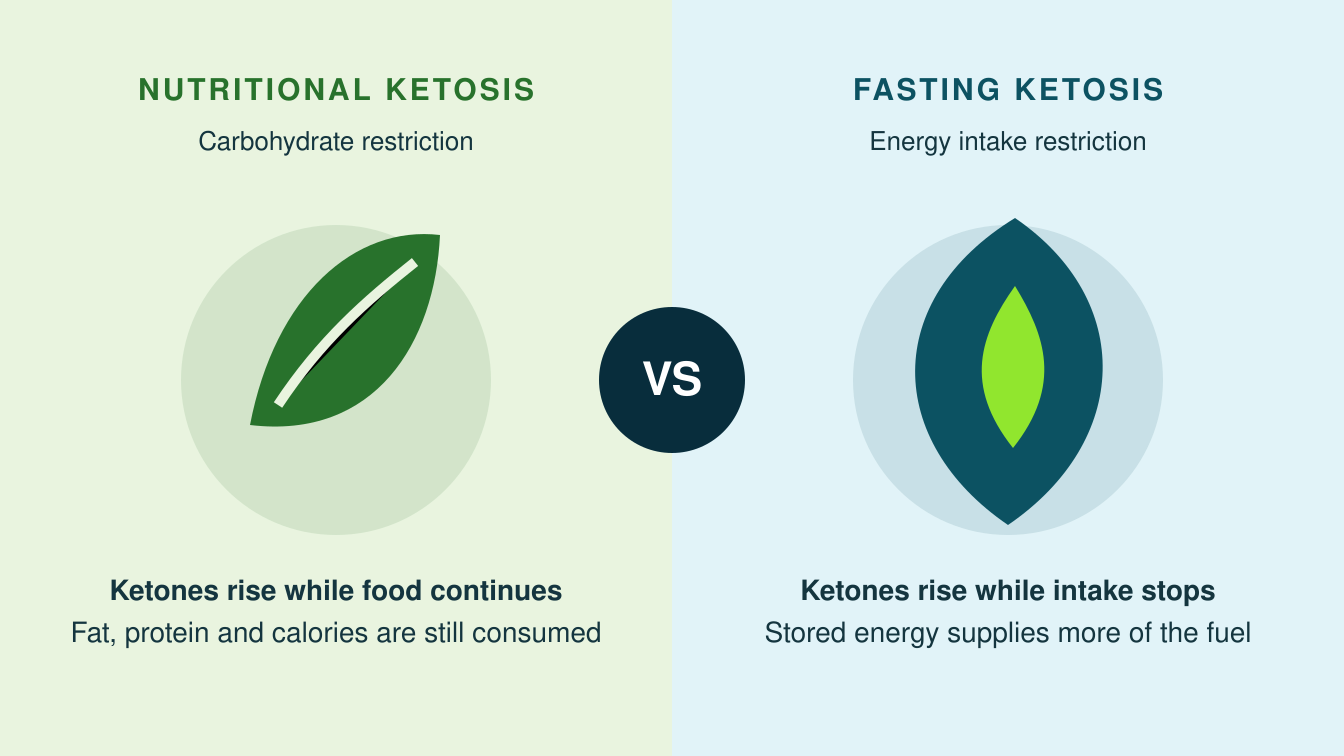
Nutritional ketosis usually refers to ketosis produced by substantial carbohydrate restriction while a person continues eating. Fasting ketosis develops when food intake stops long enough for the body to rely increasingly on stored fuel. Both can raise beta-hydroxybutyrate and acetoacetate, but the hormonal environment, incoming nutrients and degree of energy restriction are not identical.
Key takeaways
- Ketosis is a metabolic state, not a single diet. Fasting and ketogenic diets can both increase ketone production.
- Fasting ketosis uses stored fuel without incoming calories, whereas nutritional ketosis can occur while calories, protein and fat are still being consumed.
- The transition is gradual. There is no universal fasting hour when everyone suddenly “enters ketosis.”
- Higher ketones do not automatically mean greater fat loss or better health.
- Nutritional or fasting ketosis is not the same as diabetic ketoacidosis. People with diabetes—especially those using insulin or certain glucose-lowering medicines—need individualized safety guidance.
Neither state should be confused with diabetic ketoacidosis (DKA), a dangerous medical emergency most often associated with severe insulin deficiency. A ketone reading by itself also does not tell you how healthy a diet is or how much body fat someone is losing.
What is ketosis?
Ketone bodies are alternative fuels made primarily in the liver from fatty-acid-derived acetyl-CoA. The main circulating ketones are beta-hydroxybutyrate (BHB) and acetoacetate; acetone is another ketone produced in smaller amounts. When carbohydrate availability falls and insulin levels are relatively low, fat oxidation and ketogenesis generally increase.
A review of nutritional ketosis describes a commonly used research threshold of blood BHB at or above about 0.5 mmol/L. That threshold is useful for research and measurement, but metabolism exists on a continuum rather than as an on/off switch.
What is nutritional ketosis?
In a ketosis vs fasting ketosis comparison, nutritional ketosis is the eating-state side of the distinction. Nutritional ketosis usually occurs when dietary carbohydrate is restricted enough that the body increases fat oxidation and hepatic ketone production. A ketogenic diet commonly supplies most energy from fat, moderate protein and relatively little carbohydrate. People can therefore be in ketosis while continuing to eat every day.
Food quality still matters. A ketone reading does not erase concerns about inadequate fiber or micronutrients, excessive saturated fat, insufficient protein or a dietary pattern that is difficult to sustain. Mayo Clinic notes that very-low-carbohydrate diets can cause symptoms such as headache, dizziness, weakness, fatigue and constipation and may be inappropriate for some people.
What is fasting ketosis?
For ketosis vs fasting ketosis, the defining feature of fasting ketosis is the absence of incoming food energy. Fasting ketosis develops as the interval without food lengthens and the body increasingly relies on endogenous energy stores. Liver glycogen availability falls, fat mobilization rises and the liver produces more ketone bodies. During prolonged fasting, ketones can become an important fuel for the brain and other tissues.
The amount and timing vary substantially. Recent reviews of fasting physiology show that ketone concentrations rise progressively with fasting duration; they do not support a precise universal hour at which every person crosses a metabolic switch.
Ketosis vs. fasting ketosis: the key differences
| Feature | Nutritional ketosis | Fasting ketosis |
|---|---|---|
| Primary trigger | Very low carbohydrate intake | Absence of caloric intake |
| Incoming energy | Food is still consumed | Energy comes largely from stored fuels during the fast |
| Protein intake | Can continue throughout the day | No dietary protein arrives during the fasting period |
| Ketone production | Elevated because carbohydrate availability is restricted | Generally rises as fasting continues |
| Duration | Can be maintained while the diet is followed | Changes when eating resumes |
| Same as DKA? | No | No |
How quickly does fasting ketosis develop?
There is no reliable rule such as “ketosis starts at exactly 12, 16 or 18 hours.” Liver glycogen, previous carbohydrate intake, activity, energy balance, body composition and individual physiology all influence the response. Research on prolonged fasting shows ketone production rises markedly over the first several days, while shorter time-restricted eating can produce smaller changes.
This is why FMH avoids countdown-style claims about a guaranteed metabolic switch. A fasting schedule is a behavioral structure; it is not a laboratory guarantee of a specific ketone concentration.
Does fasting ketosis burn more body fat?
One practical question in a ketosis vs fasting ketosis comparison is where the immediate fuel is coming from. During a fast, a greater proportion of immediate energy needs can come from stored fuels, including body fat. But that does not mean a higher ketone reading equals greater long-term fat loss. Body-fat change over weeks and months is influenced by total energy balance, food intake after the fast, physical activity, lean-mass preservation and adherence.
Likewise, dietary fat can contribute to ketone production during nutritional ketosis. Measuring ketones alone cannot distinguish how much circulating fuel ultimately came from dietary fat versus stored body fat.
Is one type of ketosis healthier?
When considering ketosis vs fasting ketosis, the ketone state alone does not determine which approach is healthier. There is no evidence-based rule that fasting ketosis is inherently healthier than nutritional ketosis, or vice versa. The relevant question is whether the overall strategy is safe, nutritionally adequate, sustainable and appropriate for the individual.
Someone may prefer a moderate eating pattern with an overnight fast rather than a ketogenic diet. Another person may use a clinically supervised ketogenic diet for a specific indication. Ketosis itself should not be treated as the goal that overrides the rest of nutrition and health.
Ketosis is not diabetic ketoacidosis
Physiologic ketosis from fasting or carbohydrate restriction is regulated and is fundamentally different from DKA. In DKA, severe insulin deficiency can produce uncontrolled ketone accumulation, hyperglycemia and metabolic acidosis. It requires urgent medical treatment.
People with diabetes should not use consumer “ketosis” advice as a substitute for their sick-day plan or clinical instructions. Nausea, vomiting, abdominal pain, rapid breathing, confusion, marked dehydration or high glucose with ketones can require urgent evaluation.
Do you need to measure ketones?
Affiliate links: we may earn a commission at no additional cost to you. As an Amazon Associate I earn from qualifying purchases. Prices and availability can change.
For most people simply using a modest time-restricted eating schedule, routine ketone testing is not necessary. Blood BHB testing is more directly reflective of circulating BHB than urine strips, while urine ketones can vary with hydration and renal handling. Breath acetone is another indirect method.
A measurement can answer “what is my ketone level now?” It cannot by itself answer “is this diet healthy?”, “am I losing body fat?” or “is this fasting schedule better?”
Frequently asked questions
Is fasting ketosis deeper than keto-diet ketosis?
It can be, particularly as fasting becomes prolonged, but there is wide variation. “Deeper” is also not synonymous with healthier.
Can I be in ketosis without fasting?
Yes. A sufficiently carbohydrate-restricted ketogenic diet can produce nutritional ketosis while you continue eating.
Can I fast without reaching measurable ketosis?
Yes. Shorter fasts may produce only small changes in circulating ketones, and individual responses vary.
Does black coffee stop fasting ketosis?
Plain unsweetened coffee contains very little energy, but the practical meaning of “breaking a fast” depends on the purpose of the fast. It is better to define the goal than to assume one beverage determines the entire metabolic state.
Are higher ketones better?
No. In a ketosis vs fasting ketosis comparison, a higher ketone value does not establish that one approach is healthier or more effective. Higher is not automatically better, and extremely high ketones can be dangerous in pathological circumstances such as DKA.
Ketosis vs. fasting ketosis is best understood as different routes into overlapping physiology. Human fasting research clearly demonstrates rising ketone production as food deprivation continues, while ketogenic diets can create nutritional ketosis through carbohydrate restriction. What remains much less certain are many popular claims that a particular ketone number or fasting hour independently predicts better long-term health.
Where to go next
Sources & further reading
- From starvation to time-restricted eating: a review of fasting physiology
- Nutritional Ketosis with Ketogenic Diets or Exogenous Ketones: Features, Convergence, and Divergence
- Metabolic and Signaling Roles of Ketone Bodies in Health and Disease
- Mayo Clinic: very-low-carbohydrate diets, ketosis and safety considerations
Editorial standard: Fasting Metabolic Health distinguishes physiologic ketosis from diabetic ketoacidosis and does not treat ketone levels as a stand-alone measure of health or fat loss.