
Metabolism during fasting changes progressively rather than flipping like an on-off switch. As time without food increases, insulin generally falls, the liver supplies glucose from stored glycogen and newly made glucose, fat mobilization increases, and ketone production can rise.
The short answer
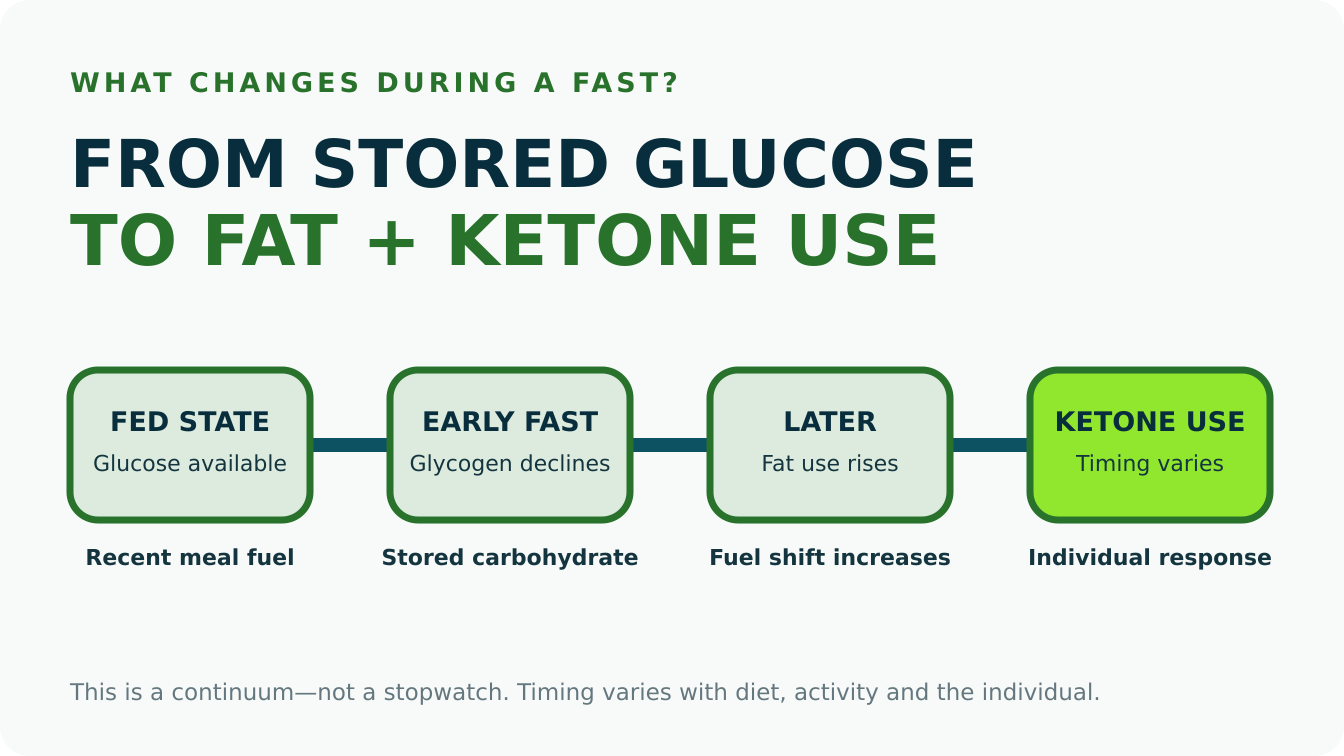
During a fast, your body keeps producing energy; it changes where that energy comes from. Early in a fast, recently absorbed nutrients and liver glycogen remain important. As the fasting period continues, fatty acids contribute more energy and the liver makes more ketones.
There is no universal hour when everyone “switches” from glucose to fat. Meal composition, activity, liver glycogen, body size, insulin sensitivity and the length of the previous eating period all influence metabolism during fasting.
Key takeaways
- Fasting does not shut down metabolism; fuel use shifts over time.
- Liver glycogen helps maintain blood glucose between meals.
- Fat oxidation and ketone production generally increase as fasting continues.
- Glucose and fat are usually used at the same time—the proportions change.
- Exact “metabolic switch” times should not be treated as universal.
What metabolism actually means
Metabolism is the collection of chemical processes that keep you alive: producing ATP, maintaining blood glucose, building and breaking down tissues, processing nutrients and regulating hormones. Metabolism during fasting is therefore much broader than “burning fat.” Your brain, liver, muscles and adipose tissue coordinate to keep usable fuel available even when no meal is entering the digestive system.
The fed state: energy is readily available
After a meal, glucose and other nutrients enter circulation. Insulin rises in response to carbohydrate and protein to varying degrees. Cells can use glucose immediately, the liver and muscles replenish glycogen, and excess energy can be stored. The body does not instantly stop burning fat after eating, but the balance shifts toward using and storing incoming nutrients.
Between meals: liver glycogen helps maintain glucose
As absorption from the last meal declines, insulin levels generally fall and glucagon becomes relatively more influential. The liver breaks down glycogen and releases glucose to help maintain blood glucose. This is one reason a healthy person can go many hours without eating while still supplying glucose-dependent tissues.
How long liver glycogen remains a major contributor varies. Exercise, carbohydrate intake, liver glycogen at the start of the fast and individual physiology all matter. Claims that glycogen is always “gone” at one exact hour oversimplify metabolism during fasting.
Fat mobilization increases
Lower insulin and changing energy demand favor lipolysis, the release of fatty acids from stored triglycerides in adipose tissue. Many tissues can oxidize these fatty acids for energy. This increasing reliance on fat is a normal part of fasting physiology, not evidence that glucose use has fallen to zero.
Ketone production rises
The liver can convert fatty-acid-derived acetyl-CoA into ketone bodies, especially as fasting extends and carbohydrate availability is lower. Ketones can be used by muscle and, as concentrations rise, by the brain. This process is called ketogenesis. Nutritional or fasting ketosis is different from diabetic ketoacidosis, a dangerous medical emergency.
For a deeper comparison, see our guide to ketosis vs. fasting ketosis.
Does fasting slow your metabolic rate?
Short fasting periods should not be equated with the long-term metabolic adaptations that can accompany prolonged energy restriction and substantial weight loss. Energy expenditure is influenced by body size, lean mass, hormones, activity and duration of calorie restriction. The practical question is not whether a single fasting window “boosts” or “crashes” metabolism, but whether the overall eating pattern is sustainable and nutritionally adequate.
What about autophagy?
Autophagy is a cellular recycling process that responds to nutrient and stress signals, and fasting-related pathways are actively studied. Human research does not establish a single fasting duration at which whole-body autophagy suddenly “turns on.” Avoid treating online hour-by-hour autophagy charts as established clinical facts.
Exercise can change the timeline
Physical activity increases energy demand and can accelerate glycogen use. Fasted exercise also tends to increase fat oxidation during the exercise session compared with fed exercise, although that does not automatically mean greater long-term fat loss. Training intensity, duration and performance goals matter. See exercise while fasting for the practical implications.
Why the timing differs between people
Metabolism during fasting is affected by the size and composition of the previous meal, carbohydrate intake, exercise, glycogen stores, sleep, insulin sensitivity, medications, illness and the duration and frequency of fasting. That variation is why we avoid claiming that ketosis or a metabolic switch always occurs at a particular hour.
Practical bottom line
The useful model is a continuum: incoming food energy declines, liver glycogen contributes to glucose maintenance, fat mobilization rises, and ketones can become increasingly important. Understanding metabolism during fasting as a gradual transition is more accurate than treating fasting as a rigid hourly sequence.
Gluconeogenesis helps protect blood glucose
As fasting continues, the liver does more than release glycogen. It can also make glucose through gluconeogenesis, using substrates such as lactate, glycerol and certain amino acids. This matters because some cells continue to require glucose even when fatty-acid use and ketone production are increasing. In other words, metabolism during fasting is not a contest in which one fuel completely replaces another.
The contribution of gluconeogenesis changes with fasting duration, activity and individual physiology. The body is continuously balancing the need to maintain blood glucose with the ability of many tissues to use fatty acids and ketones.
Insulin, glucagon and other hormones coordinate the response
Insulin generally declines when food is not being absorbed, while the relative influence of glucagon rises. Catecholamines, cortisol and growth hormone also participate in maintaining fuel availability. These signals affect glycogen breakdown, lipolysis, glucose production and the movement of fatty acids from adipose tissue.
This hormonal coordination helps explain why metabolism during fasting is dynamic. Sleep, stress, illness, exercise, medications and insulin resistance can all influence the response. Two people following the same fasting schedule may therefore have different glucose and ketone patterns.
What happens in muscle?
Skeletal muscle can use glucose, glycogen, fatty acids and ketones, with the mix changing according to exercise intensity and fuel availability. At rest and during lower-intensity activity, fatty acids can make a substantial contribution. Higher-intensity exercise relies more heavily on carbohydrate because it can supply energy rapidly.
That is one reason a fasting window may feel very different during an easy walk than during hard intervals or heavy training. It is also why a higher rate of fat oxidation during a fast should not be confused with guaranteed loss of body fat over weeks or months. Long-term body composition still reflects total energy balance, diet quality, protein intake and training.
Does the brain run out of fuel?
No. The brain normally depends heavily on glucose, but during longer periods without food it can increase its use of ketone bodies. The liver produces those ketones from fatty acids. Glucose production continues as well, so the transition is better understood as a changing mixture of fuels rather than a complete replacement of glucose.
This adaptation is an important part of human fasting physiology, but it does not mean that deeper ketosis is automatically healthier. Ketone concentration is a metabolic measurement, not a score.
What fasting can and cannot tell you about metabolic health
Researchers study intermittent fasting because meal timing may influence body weight, glucose regulation, insulin sensitivity and other cardiometabolic outcomes. Yet those outcomes are affected by calorie intake, food quality, sleep, physical activity and weight change. A fasting schedule cannot compensate for an otherwise poor-quality diet or inadequate nutrition.
For someone using fasting as one part of a health plan, the more useful question is whether the pattern improves adherence and overall metabolic health without causing adverse effects. Our intermittent fasting beginner’s guide explains how to approach the pattern conservatively.
If you choose to record weight or activity trends, our smart-scale comparison and fitness tracker guide explain which features may help and which readings have limitations. Neither device measures your metabolic rate, ketosis or autophagy.
A realistic timeline instead of an hour-by-hour promise
Online graphics often assign a specific metabolic event to each fasting hour. Human physiology is not that precise. After eating, absorption gradually declines. Liver glycogen increasingly supports blood glucose. Lipolysis and fat oxidation rise as insulin falls. Ketone production can become more prominent as fasting extends. Exercise and lower carbohydrate intake can move parts of that sequence earlier, while a large carbohydrate-rich meal can move them later.
That continuum is the most useful way to understand metabolism during fasting. It respects what is known about physiology without pretending that every person reaches the same metabolic state on the same clock.