
The prescription may be new. The question often arrives soon afterward: should you start watching your blood sugar, too? GLP-1 medicines can change glucose patterns, but the right monitoring plan depends on why you take the medicine, what else you take, and what you will do with the information. Buying the most expensive sensor is not the same as buying the most useful tool.
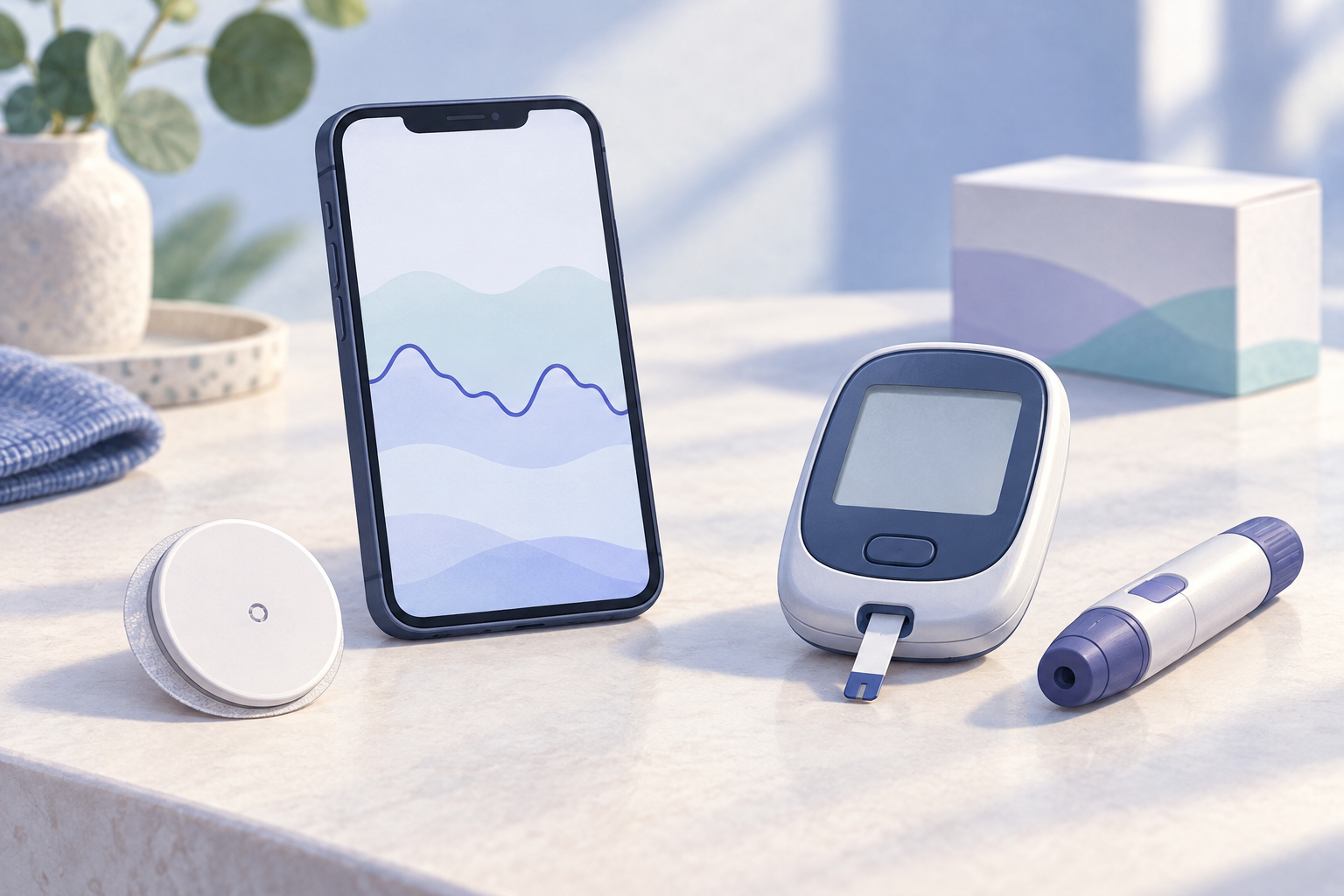
AI-generated illustration of generic devices; the graph does not show clinical measurements.
Prepared for Fasting Metabolic Health. Sources checked October 25, 2026. This guide covers U.S. devices and is educational; it has not undergone an independent clinical review.
Affiliate disclosure: As an Amazon Associate I earn from qualifying purchases. Shopping links are marked as affiliate links. They do not change the medical suitability of a device. Prices, sellers, stock, kit contents, and insurance benefits can change.
How GLP-1 drugs affect glucose—and your monitoring plan
Semaglutide, the active ingredient in Ozempic, activates the GLP-1 receptor. Its glucose-dependent actions increase insulin release and reduce glucagon when glucose is elevated; it also delays early stomach emptying. Fasting and after-meal glucose may fall during treatment. Tirzepatide, used in Mounjaro, acts at both GIP and GLP-1 receptors. These are related medicines, but they are not identical.[1] [2]
The practical issue is the rest of the prescription list. Using these medicines with insulin or a sulfonylurea can increase the risk of hypoglycemia. A prescriber may need to adjust those other medicines. Do not make that adjustment yourself because one reading looks lower.[1] [2]
Appetite changes and gastrointestinal side effects also belong in the conversation. Tell your care team if you are eating much less or cannot keep fluids down. Ozempic’s label includes dehydration-related kidney warnings and monitoring advice for people with diabetic retinopathy. A glucose graph cannot replace assessment of persistent vomiting, significant abdominal pain, or vision changes.[1]
Separate three questions before choosing a device: Is treatment improving glucose control? Do I need warnings about dangerous lows? Or am I simply curious about food responses? Each question can lead to a different purchase—or no purchase.
Who is most likely to benefit from glucose monitoring?
The American Diabetes Association’s 2026 guidance recommends CGM for adults with diabetes using insulin, noninsulin medicines that can cause hypoglycemia, and any diabetes treatment where CGM helps management. The recommendation is individualized; it does not make a wearable necessary for every person taking a GLP-1 medicine.[3]
| Your situation | Discuss with your clinician | Buying implication |
|---|---|---|
| Diabetes plus insulin or a medicine that can cause lows | Whether continuous alerts and data sharing are needed | Ask about an appropriate prescription CGM and coverage before paying cash |
| Type 2 diabetes without insulin or problematic lows | Whether ongoing CGM, a limited sensor trial, or scheduled finger-stick checks would answer the treatment question | An eligible OTC device may be an option; compare it with covered care |
| GLP-1 treatment for weight management, without diabetes | Whether glucose data would change any recommended action | Do not assume a monthly sensor subscription is necessary |
| Symptoms suggesting low glucose | A symptom and treatment plan, including how to confirm readings | A wellness sensor without low alerts is not a substitute for clinical evaluation |
Ask for a concrete monitoring goal before buying. For example: “We want to understand the overnight pattern,” or “We want to compare readings before and after a treatment change.” A purpose makes it easier to judge whether the recurring cost is justified.
Continuous glucose monitor or finger-stick meter: what is the difference?
A CGM uses a small sensor under the skin to estimate glucose in the fluid around cells. It records patterns across the day and night. A finger-stick meter tests a small blood sample at one moment. CGMs can reduce routine finger sticks, but users still need access to blood glucose testing for situations specified in the device instructions.[4]
“Continuous” does not mean permanent or maintenance-free. Sensors have replacement schedules. App compatibility, Bluetooth range, alert settings, replacement support, and ongoing sensor expense matter as much as the first box. A lower upfront meter price can also be misleading if its strips are difficult to obtain.
For occasional checks, compare a meter’s total cost over several months. For ongoing monitoring, compare the sensor supply and the functions you actually need. Do not pay for overlapping devices simply because a bundle makes them look complementary.
Glucose-monitor options to consider while taking a GLP-1
1. Prescription CGMs: start here if you need clinical alerts
Dexcom’s G7 systems and Abbott’s FreeStyle Libre systems are examples to discuss with a diabetes care team. Choose the exact device, age indication, alerts, and compatible phone or reader with professional guidance. Check prescription and insurance routes before shopping for sensors independently. Dexcom and Abbott both describe glucose-alert functions and device-specific limitations in their product guidance.[17] [18]
A listing called “sensor cover,” “patch,” or “replacement adhesive” is not a glucose sensor. Do not order a less expensive accessory expecting it to take readings. Also confirm that sensors, readers, and apps belong to the same compatible system and U.S. version.
2. Stelo: an OTC continuous option for eligible adults
Stelo is intended for adults 18 and older who do not use insulin. It is not for people with problematic hypoglycemia and is not designed to provide the low-glucose safety alerts those patients may need. FDA clearance does not make its output permission to change medication without a clinician.[5]
Dexcom lists up to 15 days of wear per sensor and directs buyers to check phone compatibility. It also identifies Amazon as a purchasing channel. The linked two-sensor listing is a shopping option, not a guarantee of 30 uninterrupted days or a recommendation for every GLP-1 user.[6] [7]
Check the Stelo two-sensor listing on Amazon. Affiliate link. Verify the seller, exact product, expiration dates, app compatibility, replacement policy, and whether checkout selects a one-time purchase or subscription.
This option fits the article’s continuous-monitoring focus only after the eligibility question is answered. If you require low alerts or take insulin, discuss a different device rather than buying Stelo as a cheaper substitute.
3. CONTOUR NEXT ONE: a finger-stick option
CONTOUR NEXT ONE belongs to Ascensia’s connected-meter range. It uses CONTOUR NEXT strips; similarly named strips are not automatically interchangeable. If your care team recommends spot checks or a backup meter, compare the kit and the ongoing strip supply together.[8] [16]
Compare CONTOUR NEXT ONE kits on Amazon. Affiliate shopping search. Compare what each kit actually includes; a meter, lancing device, strips, lancets, and control solution may be sold separately.
4. OneTouch Verio Reflect: another finger-stick option
OneTouch Verio Reflect uses OneTouch Verio test strips. Its manufacturer describes color-based result guidance and an app that can log readings and share them with a care team. It provides a single blood-glucose result when you perform a test, not continuous monitoring or automatic overnight low alerts.[9]
Check the OneTouch Verio Reflect listing on Amazon. Affiliate link. Check kit contents and the cost and availability of the correct strips before ordering.
These are feature-based options, not a hands-on accuracy ranking. We have not independently tested these devices. A meter that is covered by your plan, supported by your clinician, and easy for you to use may be the better choice.
A note about wellness sensors such as Lingo
Abbott distinguishes Lingo’s wellness use from diabetes-management devices. Do not substitute a wellness sensor for the monitor prescribed for diabetes. Similar-looking wearables can serve different intended users; the exact U.S. labeling matters more than appearance or marketing around weight loss.[12]
Useful supplies—and what you can skip
The sensible shopping basket is usually small: the chosen monitoring system, its required consumables, and a few items that solve a real handling or safety problem. Start with what comes in the kit.
- Matching test strips: Compare CONTOUR NEXT strip listings for the CONTOUR NEXT ONE, or OneTouch Verio strip listings for the Verio Reflect. Check the exact compatibility, sealed packaging, expiration date, and cost per usable strip. Affiliate searches.
- Lancets: Compare glucose-testing lancets, then match them to your lancing device. “Universal” in a listing is not proof that a lancet fits your device. Affiliate search.
- Control solution: Search CONTOUR NEXT control solution or search OneTouch Verio control solution. Match the meter instructions, solution type, and expiry. Control solution checks the meter-and-strip system; it does not measure your glucose. Affiliate searches.
- A sharps container: Compare home sharps containers, checking the individual product’s labeling and your local disposal rules. Never assume a sensor applicator and a used lancet have identical disposal instructions. Affiliate search.
- A carrying case: Compare glucose-meter cases if the included case is unsuitable. Keep supplies within the temperature limits in their instructions. Affiliate search.
Ascensia specifically describes control testing for first use, new strip packages, suspected meter problems, or repeated unexpected results. Follow your own meter’s instructions rather than assuming one schedule applies to every brand.[8]
For CGM adhesion, first check the supplied overpatch and manufacturer instructions. Stelo already includes an overpatch. An additional Stelo overpatch shopping search may be useful only if the sensor instructions permit it and it solves a real adhesion issue. Match the exact model, avoid covering parts that must remain uncovered, and stop using an adhesive that irritates your skin. Affiliate search; compatibility must be checked.
If your care plan includes treating low glucose, compare glucose-tablet options and check the carbohydrate amount per tablet or serving. They are an emergency supply for people who need them, not a routine snack or something every GLP-1 user must buy. Affiliate search.
Do not add ketone testing solely because you take a GLP-1 medicine. Ketone checks answer a different question and should follow a clinical indication. Readers already advised to monitor ketones can use our blood ketone meter comparison.
How to read glucose data without overreacting
Begin with patterns your clinician considers relevant. For diabetes care, time in range, time below range, and glucose variability can be more informative than chasing one isolated peak. The ADA describes a 70–180 mg/dL range for many adults with diabetes, with individualized goals. That diabetes-management range is not a universal “ideal” target for everyone wearing a wellness sensor.[15]
Blood and sensor values can differ, especially while glucose is changing. If readings do not match symptoms, follow the device instructions for meter confirmation and get medical advice as appropriate. Dexcom also documents pressure-related falsely low nighttime readings for its G6; this illustrates why an unexpected sensor result requires context, not an automatic assumption that treatment has failed.[4] [11]
Before your follow-up, record the medicine name and dose, relevant treatment changes, meal timing, symptoms, activity, and the question you want the data to answer. Keep meals nutritionally sensible rather than trying to produce the flattest possible graph. A good-looking curve does not measure protein adequacy, overall diet quality, or whether a treatment is right for you.
Home meters and consumer glucose graphs do not establish a diabetes diagnosis. Arrange appropriate laboratory testing and clinical assessment rather than diagnosing yourself from a shopping purchase.[13]
Low glucose: make the response plan before you need it
For many people with diabetes, a reading below 70 mg/dL requires action under their treatment plan. If you are awake and able to swallow safely, NIDDK describes taking 15–20 grams of fast-acting carbohydrate, checking again after 15 minutes, and repeating if still low. Follow your clinician’s individualized instructions. Do not delay treating a suspected significant low to preserve a fast.[10]
Severe confusion, a seizure, unconsciousness, or inability to swallow safely is an emergency. Call 911; a trained helper should give prescribed glucagon if available. Do not give food or drink by mouth to someone who cannot swallow safely. Recurrent lows need prompt clinical review, not simply another device purchase.[10]
A sensor cannot make prolonged fasting safe. Before combining fasting with glucose-lowering medicines, ask your prescriber for a monitoring and medication plan. See our fasting safety guide and fasting schedule comparison for background, rather than treating a schedule as a medication instruction.
Before you buy: six questions worth asking
- Purpose: What decision will this monitor help me and my care team make?
- Eligibility: Is this exact device intended for my age, diagnosis, insulin use, and low-glucose risk?
- Alerts: Do I need clinical low-glucose warnings, and does the chosen model provide them?
- Total cost: What will sensors or strips cost over three months, after coverage and any subscription?
- Compatibility: Will the app, phone operating system, reader, strips, and lancets work together?
- Support: Who handles an early sensor failure, an unexpected result, or a replacement?
Once those answers are clear: Check the Stelo two-sensor listing on Amazon; Compare CONTOUR NEXT ONE kits on Amazon; or Check the OneTouch Verio Reflect listing on Amazon. Affiliate links. Stelo’s eligibility restrictions still apply. Meter options are for spot checks or backup use, not replacements for needed CGM alerts.
Frequently asked questions
Do I need a CGM just because I take Ozempic or Mounjaro?
No automatic requirement follows from the medicine name alone. Your diabetes status, other medicines, history of lows, and treatment goals determine whether ongoing CGM, spot checks, or clinician-directed testing is useful.
Does a lower glucose curve prove the medicine is working better?
Not by itself. Review the pattern with your clinical goals and symptoms. Lower is not always safer, and a graph cannot replace your scheduled clinical follow-up.
Can an ordinary glucose meter be useful if I already wear a sensor?
Yes. Keep a compatible meter and fresh supplies available for circumstances specified by your CGM instructions, including some mismatches between symptoms and readings. Know the confirmation procedure before a problem arises.
Can a smartwatch replace a glucose monitor?
A watch that displays readings from a compatible authorized CGM is different from a watch claiming to measure glucose independently without piercing the skin. FDA has warned against using unauthorized watches and rings making that claim. Do not buy one as a substitute for a legitimate glucose-testing system.[14]
Is glucose monitoring a way to optimize weight loss without diabetes?
First ask what the data would change. Curiosity can justify a personal experiment within device labeling, but a recurring purchase should not be presented as essential weight-loss treatment. More measurements do not automatically mean better decisions.
Choose the monitoring question before the monitor
For someone at risk of dangerous lows, the right prescription monitor and a clear response plan can matter far more than a cheaper cash price. For someone who needs occasional checks, a reliable finger-stick meter with affordable matching strips may be sufficient. For an eligible adult interested in continuous patterns, an OTC sensor can be considered with realistic expectations.
The useful purchase is the one that answers a worthwhile question and supports an agreed action. Start there, then compare products.
Medical note: This article does not provide a diagnosis, prescribe a monitoring frequency, or recommend changes to GLP-1 medicines, insulin, or other treatment. Device labeling and your qualified clinician’s instructions take priority. Product selection here is based on published information, not independent clinical or hands-on testing.
Sources and product information
- Ozempic prescribing information (FDA, 2026).
- Mounjaro prescribing information (FDA).
- ADA Standards of Care 2026: Pharmacologic Approaches, recommendation 9.25.
- NIDDK: Continuous Glucose Monitoring.
- FDA: First over-the-counter CGM clearance and Stelo limitations.
- Dexcom: How Stelo works.
- Dexcom: Where to buy Stelo.
- Ascensia: CONTOUR NEXT test-strip instructions.
- OneTouch: Verio Reflect meter.
- NIDDK: Low Blood Glucose (Hypoglycemia).
- Dexcom: Pressure-related nighttime sensor readings.
- Abbott: OTC CGMs and Lingo suitability.
- NIDDK: Diabetes Tests and Diagnosis.
- FDA: Watches and rings claiming to measure glucose without piercing skin.
- ADA Standards of Care 2026: Glycemic Goals and CGM metrics.
- Ascensia: CONTOUR NEXT meter FAQs.
- Dexcom: G7 systems and Stelo intended users.
- Abbott: FreeStyle Libre glucose alarms.
- Dexcom: Stelo package components.