
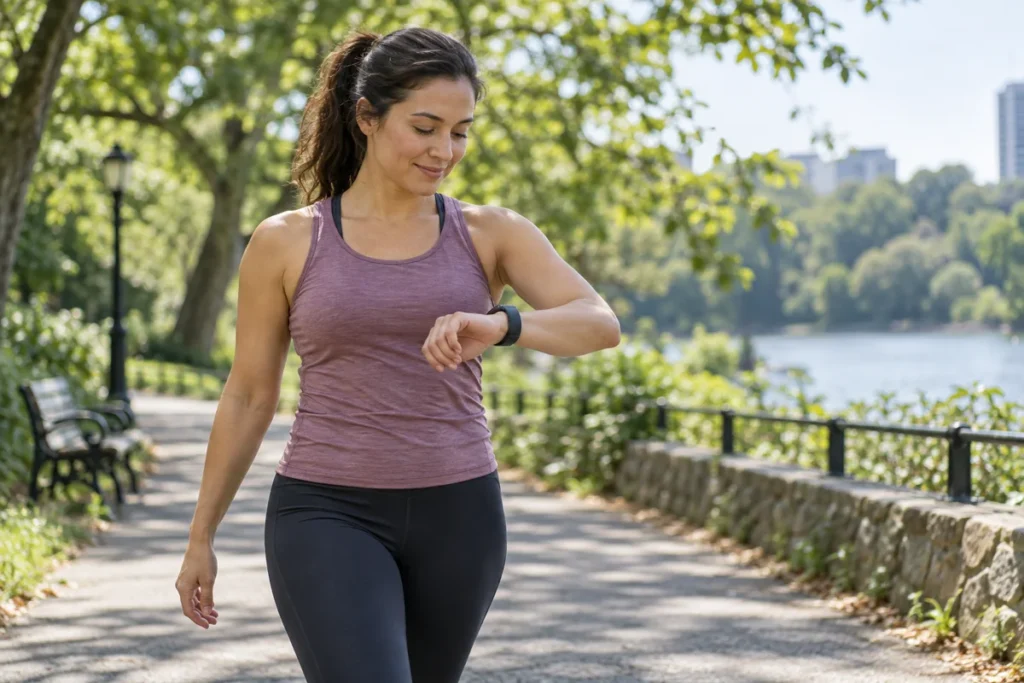
Fitness trackers for fasting cannot tell you whether you are in ketosis or whether a fast is “working.” What they can do is make useful patterns easier to see: daily movement, workout intensity, resting heart rate, sleep consistency, and recovery trends. Used sensibly, those signals can help you plan activity around an intermittent fasting schedule without turning every number into a medical verdict.
Disclosure: This article contains Amazon and Amazfit affiliate links. As an Amazon Associate I earn from qualifying purchases. If you buy through an affiliate link, Fasting Metabolic Health may earn a commission at no additional cost to you. Our evaluation criteria and conclusions are editorially independent.
Quick picks: the best fitness trackers for fasting
| Best for | Current option | Why it stands out | Main tradeoff |
|---|---|---|---|
| Value-focused everyday smartwatch | Amazfit Bip 6 Check price at Amazfit | 1.97-inch AMOLED display, built-in GPS and 140+ workout modes; up to 14 days of typical-use battery life stated by Amazfit | Larger than a narrow fitness band; battery life varies with settings and use |
| Simple all-around tracking | Fitbit Charge 6 Check price on Amazon Fitbit Charge 6 | Slim design, built-in GPS, exercise modes, sleep and stress features | Some insights may depend on the Fitbit ecosystem or subscription |
| iPhone users | Apple Watch Series 12 Check price on Amazon Apple Watch Series 12; check case size and connectivity at checkout | Broad health, safety, workout and sleep features with close iPhone integration | Shorter battery life than many bands; iPhone required |
| Training and recovery without a monthly fee | Garmin vívoactive 6 Check price on Amazon Pebble Gray/Slate | Strong workout tools plus HRV, stress, sleep and recovery-oriented trends | More data and menus than a casual user may want; optional Garmin Connect+ extras cost more |
| Screen-free recovery coaching | WHOOP 5.0 Check price on Amazon WHOOP 5.0 with 12-month Peak membership; renewal is needed for continued membership services | Continuous strain, sleep and recovery emphasis without an on-wrist screen | Ongoing membership is central to the product |
| Screen-free Garmin users | Garmin CIRQA Smart Band Search Amazon listings | Discreet band with Garmin Connect health and recovery metrics | Newer product with less long-term consumer history |
Our practical pick for most people: Fitbit Charge 6 offers a useful balance of comfort, activity tracking and a less distracting form factor. Apple Watch Series 12 is the stronger choice for people already committed to the iPhone, while Garmin vívoactive 6 better suits users who want deeper workout data and longer-wearing convenience. WHOOP 5.0 makes the most sense for recovery-focused users who accept a subscription. If value and charging frequency are priorities, also compare Amazfit Bip 6 and read our detailed Bip 6 review.
What a fitness tracker can—and cannot—tell you during fasting
Fitness trackers for fasting are behavior tools, not metabolic testing devices. A wrist wearable may estimate steps, heart rate, sleep duration, activity minutes and workout load. Algorithms may also combine several signals into a readiness, energy or recovery score. Those outputs can help you decide whether today is better suited to an easy walk or a demanding training session.
A conventional tracker does not directly measure blood glucose, ketones, hydration status, calorie absorption or the safety of continuing a fast. The U.S. Food and Drug Administration has specifically warned consumers not to rely on smartwatches or smart rings that claim to measure blood glucose without piercing the skin. The agency has also warned against unauthorized wearable blood-pressure features. Treat marketing claims that promise effortless glucose or blood-pressure readings with skepticism.
Heart-rate, calorie and sleep-stage estimates also have limits. Fit, skin contact, motion, temperature, exercise type and individual physiology can affect readings. Look at multi-day trends rather than reacting to one unusual number. Symptoms such as chest pain, fainting, severe weakness, confusion or persistent palpitations deserve appropriate medical attention—not another glance at an app.
How we evaluated fitness trackers for fasting
We did not rank devices by the number of sensors printed on a box. The best fitness trackers for fasting should help someone build a repeatable routine. Our criteria were:
- Wearability: A tracker only produces useful trends when it is comfortable enough to wear consistently, including during sleep if sleep insights matter to you.
- Battery and charging friction: Frequent charging creates gaps. Real-world battery life varies with GPS, display settings and health features.
- Useful movement data: Steps, active minutes, heart-rate zones, GPS and workout logging should be understandable and easy to review.
- Sleep and recovery context: Sleep duration and recovery trends can help prevent an aggressive fasting plan from crowding out rest.
- Phone compatibility: Apple Watch requires an iPhone. Other devices may work across platforms but still offer different features by phone or region.
- Ongoing cost: Some platforms reserve advanced insights for a subscription. We consider the total ownership model, not merely the device price.
- Data restraint: A useful tracker should encourage decisions, not anxiety. More metrics are not automatically better.
Fitbit Charge 6: best for most beginners
The Charge 6 remains a practical starting point for someone who wants fitness trackers for fasting without wearing a full smartwatch. Google describes it as a premium fitness tracker with built-in GPS, heart-rate tracking, exercise tools and access to sleep and stress features. Its narrow profile is easier to wear overnight than many large watches.
For a fasting routine, the most useful information is usually ordinary: Did you walk today? Was a fasted workout unusually difficult? Are late meals or an inconsistent schedule associated with shorter sleep? Charge 6 can help organize those observations without pretending to diagnose why they occurred.
Best for: beginners, walkers and users who want a compact screen.
Skip it if: you dislike subscriptions or want detailed endurance-training tools.
Check Fitbit Charge 6 on Amazon — Fitbit Charge 6.
Apple Watch Series 12: best for iPhone users
Apple Watch Series 12 combines activity and workout tracking with sleep score, heart-rate notifications and other supported health features. Its greatest advantage is not one fasting-specific metric; it is the polished integration among the watch, iPhone, Health app and supported third-party apps. For a closer look at phone fit, charging and wellness metrics, read our Apple Watch Series 12 vs Garmin Venu 4 sleep and recovery comparison.
That makes it a strong choice for an iPhone owner who also values safety, communication and smartwatch functions. The compromise is charging frequency. If overnight sleep data is a priority, build charging into a shower or desk routine so the watch does not spend every night on its charger. For a Garmin alternative focused on sleep and lifestyle trends, compare Garmin Venu 4 41 mm on Amazon — the black-silicone model, with a manufacturer battery claim of up to 10 days in smartwatch mode; actual runtime varies.
Best for: iPhone owners wanting one device for health, safety and everyday smart features.
Skip it if: multi-day battery life or Android compatibility is essential.
Check Apple Watch Series 12 on Amazon — Apple Watch Series 12; check case size and connectivity at checkout. Series 12 includes sleep score, readiness and heart-rate tracking; supported health features depend on eligibility and region. Apple specifies iPhone 11 or later (including iPhone SE, 2nd generation or later) with iOS 27 or later.
Garmin vívoactive 6: best for training detail without a required subscription
Garmin’s vívoactive 6 is built for people who want more workout structure than a basic band provides. Garmin highlights HRV status, stress tracking, sleep information, activity profiles and recovery-oriented context. The Garmin Connect platform can be especially useful when someone is comparing training response across fed and fasted sessions. Core tracking does not require a subscription, but “no required subscription” does not mean every feature is free: the vívoactive 6 manual describes optional Garmin Connect+ extras, including Active Intelligence insights and enhanced dashboards. Check the current paid-feature list before buying. Subscription distinction checked October 29, 2026.
Do not assume a low recovery or “energy” score proves that fasting caused a problem. Travel, poor sleep, illness, alcohol, heat, work stress and training volume can all influence the same signals. Use the data to ask better questions, then adjust one variable at a time.
Best for: active users who like detailed trends and do not want core analytics tied to a mandatory membership.
Skip it if: you prefer a very simple app and minimal metrics.
Check Garmin vívoactive 6 on Amazon — Pebble Gray/Slate.
WHOOP 5.0: best for screen-free recovery coaching
WHOOP 5.0 removes the conventional watch face and focuses on strain, sleep and recovery through its app. That screen-free design can reduce distraction, and the platform is built around daily interpretation rather than occasional step checks.
The purchasing decision is inseparable from membership. WHOOP’s current plans bundle the device with software access and coaching features, so compare the full annual commitment with a watch you purchase outright. It is best for someone who will actually use recovery guidance—not a person who simply wants a step count.
Best for: committed exercisers who value recovery trends and prefer no screen.
Skip it if: you want an ordinary watch, on-device stats or no recurring cost.
Check WHOOP 5.0 on Amazon — WHOOP 5.0 with 12-month Peak membership; renewal is needed for continued membership services.
Garmin CIRQA Smart Band: best new screen-free alternative
Garmin introduced the CIRQA Smart Band in 2026 as a screen-free health and fitness tracker. It sends data such as wrist-based heart rate, stress, skin temperature and Garmin’s Body Battery information to Garmin Connect. This makes it an interesting alternative for someone who wants discreet tracking but prefers Garmin’s ecosystem to a membership-centered platform.
Because it is newer, shoppers should verify current phone compatibility, included features and availability before purchase. We also want more independent, long-term experience before naming it the default choice over established models.
Best for: Garmin users wanting unobtrusive day-and-night tracking.
Skip it if: you want a mature product with years of user feedback or an on-device display.
Search Garmin CIRQA on Amazon
Affiliate shopping search, not a verified exact listing. Confirm the model, band size, seller and current availability. Garmin’s CIRQA announcement documents its screen-free design and core features without a required subscription.
Amazfit Bip 6: a value-focused option for everyday activity
The Bip 6 is worth comparing if you want a larger watch display, GPS walks and routine activity records. Amazfit lists a 1.97-inch AMOLED screen, 140+ workout modes and up to 14 days of typical-use battery life; its heavy-use estimate is up to six days. These are manufacturer specifications, not FMH battery-test results. GPS use and display settings affect charging frequency.
Best for: someone prioritizing ordinary workouts and fewer charging interruptions.
Check first: case fit, current Zepp app requirements, phone compatibility and the features you will actually use. A watch does not measure fasting safety or ketones. Our Amazfit Bip 6 review covers buying considerations in more detail.
Check Amazfit Bip 6 price and availability
Amazfit affiliate link. Price and availability can change. Manufacturer specifications checked October 24, 2026.
Using a tracker with intermittent fasting
- Establish a baseline first. Wear the device for one or two normal weeks before drawing conclusions about a new fasting schedule.
- Track the behaviors you can control. Focus on walking, workouts, bedtime consistency and perceived energy rather than chasing a proprietary score.
- Compare similar days. A hard interval session and a gentle walk should not be interpreted the same way.
- Record symptoms separately. A brief note about dizziness, headache, medication timing or poor sleep can add context that a wearable cannot detect reliably.
- Avoid compensatory exercise. Do not treat activity calories as permission to extend a fast or punishment for eating.
- Review weekly trends. Daily fluctuations are noisy. A weekly review is more useful than repeatedly checking the app.
If you are new to combining training and fasting, read our guide to exercise while fasting. Sleep is equally important; our article on intermittent fasting and sleep explains why meal timing and rest should be considered together.
Who should get medical guidance first?
Talk with a qualified clinician before fasting if you use insulin or medicines that can cause low blood glucose, are pregnant or breastfeeding, have a history of an eating disorder, are underweight, are a child or adolescent, or have a condition that makes fluid, electrolyte or medication timing especially important. A fitness tracker does not make an unsafe fasting plan safe.
People with pacemakers or other implanted medical devices should also follow device-specific instructions. The FDA advises keeping consumer electronics that may create magnetic interference, including smartwatches, at least six inches from implanted medical devices such as cardiac defibrillators. Ask your medical-device team about the guidance for your specific implant.
Frequently asked questions
Can a fitness tracker tell whether I am fasting?
No. Most trackers cannot know when you last consumed calories unless you enter that information or connect a fasting app. They infer activity and physiological trends; they do not directly verify a fast.
Can a smartwatch measure blood glucose without a sensor under the skin?
No consumer smartwatch or smart ring has FDA authorization to measure or estimate blood glucose on its own without piercing the skin. Avoid products that claim otherwise.
Which metric matters most during a fast?
There is no single fasting metric. For most people, sleep duration, resting-heart-rate trends, ordinary movement and how they actually feel are more useful than a composite readiness score.
Should I stop a workout when my tracker shows a high heart rate?
Slow down and assess how you feel, but do not use a consumer device as the sole basis for a medical decision. Stop exercising and seek appropriate care for concerning symptoms such as chest pain, fainting, severe shortness of breath or a persistent abnormal rhythm.
Are calorie-burn estimates accurate enough to plan meals?
They are estimates and can vary considerably. Use them as broad context, not as a precise amount to “eat back” or a reason to extend fasting.
Bottom line
The best fitness trackers for fasting are the ones that reduce friction and improve decisions. Fitbit Charge 6 is the balanced entry point, Apple Watch Series 12 is strongest for iPhone integration, Garmin vívoactive 6 serves data-minded exercisers, WHOOP 5.0 suits subscription-friendly recovery enthusiasts, and Garmin CIRQA offers a promising new screen-free route.
Choose the smallest set of metrics that helps you act: move regularly, train appropriately, sleep consistently and notice when your body is telling you to pause. The tracker should support those habits—not become another source of stress.
Compare purchase options: Amazfit Bip 6 at Amazfit ·Fitbit Charge 6 · Apple Watch Series 12 · Garmin vívoactive 6 · WHOOP 5.0. Check the selected case size, band fit, phone compatibility, membership terms and device configuration before ordering.
Sources and further reading
Our product comparisons use published specifications and documentation rather than hands-on testing. For the sleep and recovery comparison added to this guide, see Apple’s Series 12 feature and compatibility documentation and Garmin’s Venu 4 feature documentation. Battery figures are manufacturer estimates, not results from a shared FMH test.
- Amazfit: Bip 6 specifications, battery-use assumptions and phone support
- U.S. FDA: Do Not Use Smartwatches or Smart Rings to Measure Blood Glucose
- U.S. FDA: Do Not Use Unauthorized Devices for Measuring Blood Pressure
- The Lancet Digital Health: Effectiveness of wearable activity trackers to increase physical activity
Medical disclaimer: This article is for general educational purposes and is not medical advice. Fitness trackers are not a substitute for diagnosis, treatment or individualized guidance from a qualified healthcare professional.